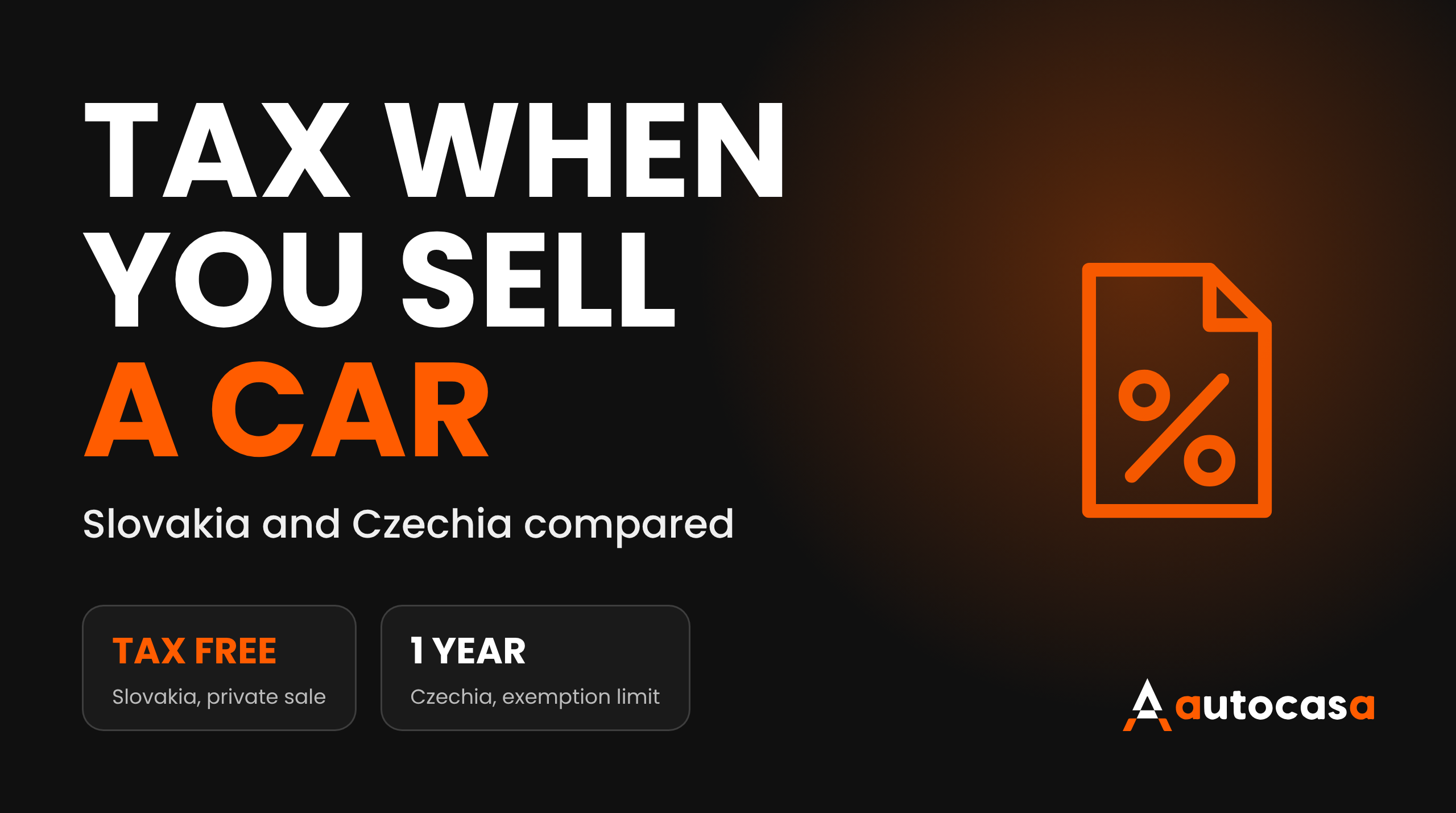
Autumn is a strong season for selling a car. Before winter, plenty of people part with the second car, the motorbike or the van that sat unused all year. As soon as the money lands in the account, the question that can spoil a good deal arrives: do you owe tax on the sale? If you are selling in Slovakia or in Czechia, the two countries give different answers.
In Slovakia a private sale is tax free
If you sell a car you owned as a private individual and which was never part of business assets, the proceeds are exempt from income tax under § 9 (1) (c) of Slovak Act No. 595/2003 Z. z. The exemption covers the full amount and does not depend on how long you owned the car or what you sold it for.
In practice: you buy a car in March for 6,000 euros, sell it in October for 7,000 euros, and report the difference nowhere. Exempt income is not entered in the Slovak tax return, so selling a car does not create a filing obligation on its own. The same rule covers a motorbike, a trailer, a set of wheels or spare parts from the garage.
In Czechia one year decides
The Czech rules are stricter. The Income Tax Act exempts the sale of movable property, but makes an exception for motor vehicles, boats and aircraft: the exemption applies only if more than one year passed between acquisition and sale (§ 4 (1) (c) of Act No. 586/1992 Sb.).
Sell the car in Czechia sooner than a year after buying it and the proceeds are taxable other income under § 10, reported in Annex No. 2 of the Czech tax return. The period runs from acquisition of the vehicle, not from the day you registered it in your name. Between the eleventh and the thirteenth month of ownership there can be several hundred euros of tax at stake.
What is actually taxed in Czechia
The good news is that the tax hits the gain, not the whole selling price. You can deduct:
- the purchase price of the car – which is why the purchase contract or proof of payment matters so much,
- documented selling costs, for example a commission or paid listings,
- documented repairs and improvements backed by invoices.
Sell for less than you paid and there is no tax. The loss, however, cannot be offset against other income such as employment. The gain is taxed at the basic income tax rate of 15 %.
A Czech tax return is filed by anyone whose annual income exceeded CZK 50,000. An employee must file if other income exceeded CZK 20,000 a year – and a car sold within a year of purchase counts towards that. The paper return is due within three months after the end of the year, the electronic one within four.
A company car follows its own rules
The Slovak exemption does not cover cars held in business assets. If the vehicle is still recorded as a business asset on the day of sale, the proceeds are business income under § 6 of the Slovak act.
Watch the five-year period as well. If a sole trader removes the car from business assets and sells it sooner than five years after that, the income is taxable under § 8 (1) (c). The period runs from the last day the vehicle appeared in the accounts or in the tax records. After five years the sale is exempt again.
Paperwork worth keeping
- The purchase contract with date and price, both from buying and from selling. In Czechia they determine the amount of tax.
- Proof of payment – a bank statement or a receipt for cash handed over.
- Invoices for major repairs and equipment from the time you owned the car.
- Photos of the condition at the time of sale. Irrelevant for tax, but useful in a dispute over hidden defects.
One more note. If you buy and resell cars repeatedly with the intention of making money, the authorities may treat it as a business activity – the private exemption then no longer applies and different rules take over. For a large or unusual transaction, one question to a tax adviser before signing pays for itself.
Paperwork clear, now find the buyer
In a private sale in Slovakia, income tax takes nothing off the figure in the contract. All the more reason to look at what the intermediary takes. On AutoCasa, listings are free, with no commission on the sale and no limit on the number of ads. Promoting a listing is optional and starts at 1.50 euros.
You can post in the categories cars, motorbikes, vans and trucks, buses, trailers, spare parts, wheels and tyres, and bicycles. To sell faster, state the real mileage, the validity of the Slovak technical and emissions inspection, the service history, and add photos of the interior and the engine bay as well.
This article is based on Slovak Act No. 595/2003 Z. z. on income tax and Czech Act No. 586/1992 Sb. as in force in October 2026. The rules described apply to Slovakia and Czechia, not to other countries, and are not tax advice – for a specific case consult a tax adviser or the tax administration.


 Slovenčina
 Čeština
 Angličtina
 Nemčina
 Poľština
 Slovinčina
 Ruština
 Taliančina
 Maďarčina
 Francúzština


Zatiaľ tu nie sú žiadne komentáre. Buďte prvý!