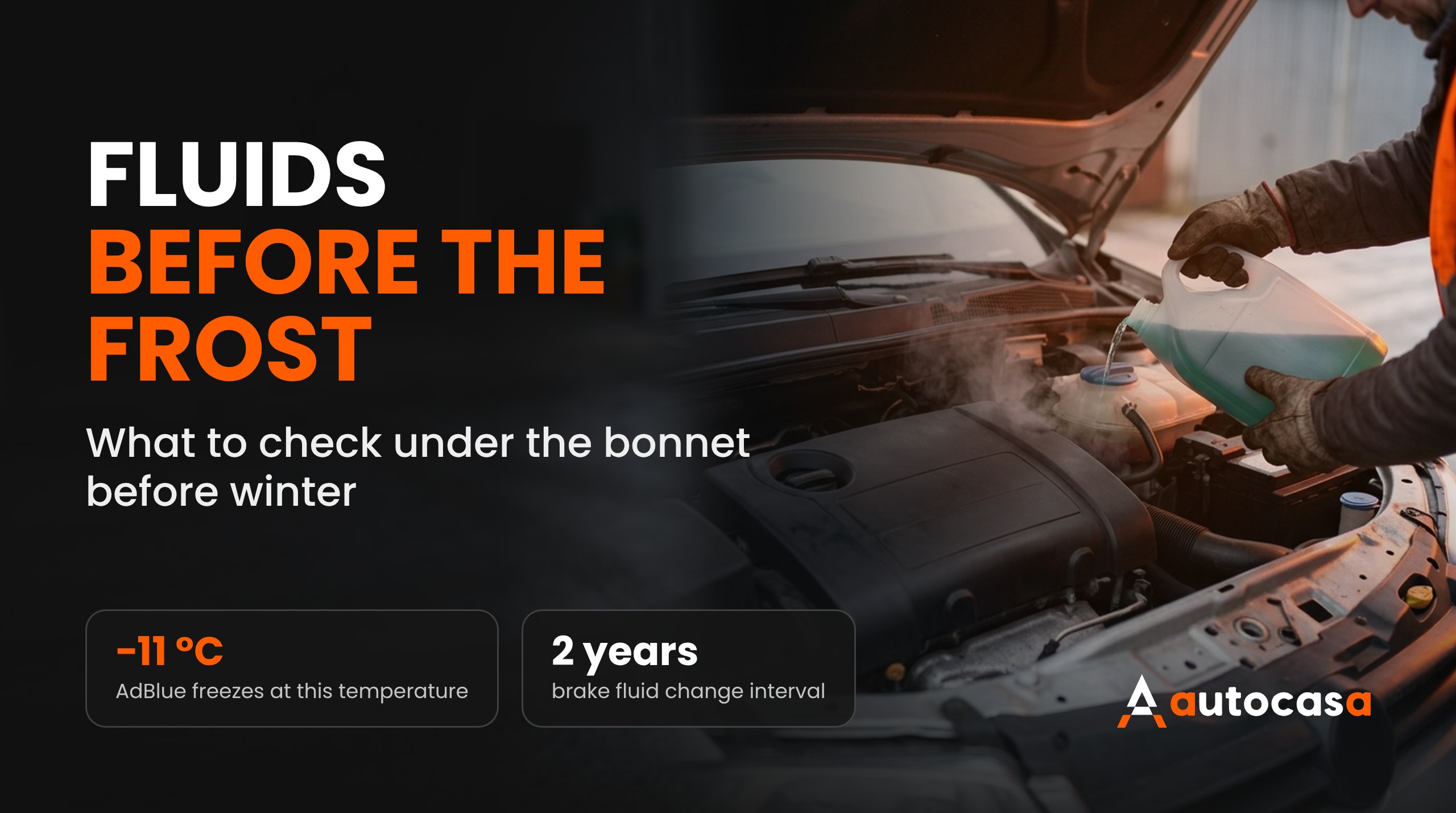
In Slovakia and Czechia the first frosty mornings usually arrive in the second half of October. Most drivers think about tyres and the battery at that point and leave the fluids under the bonnet for later. Yet those are what ruin a winter fastest, and guarding against it is the cheapest job on the list: a frozen washer system, split hoses or a longer stopping distance can all be avoided with fifteen minutes of checks in the car park.
Coolant is not „just water“
Coolant does more than cool the engine. The mix of glycol, water and inhibitors protects aluminium, rubber and seals from corrosion and raises the boiling point. Before winter what matters most is its frost protection: it should reach at least minus 25 °C, while modern Si-OAT mixtures cope with minus 40 °C. A workshop measures it in a minute; at home a cheap refractometer is enough.
The most common mistake is topping up with ordinary tap water. It carries minerals that settle in the system and encourage corrosion, and at the same time it dilutes the protection to a level where the radiator can freeze in January. If you do top up, use the same type of ready-mixed coolant, or concentrate diluted with distilled water.
The type matters too. Older G11 with inorganic inhibitors must not be mixed with G12; G12, G12+, G12++ and G13 tolerate each other without critical consequences, according to workshops. Change intervals depend on the technology: classic IAT mixtures last two to three years or 40,000–50,000 km, modern OAT and HOAT five years, and Si-OAT fluids up to ten years or 250,000 km according to manufacturers. Brown, cloudy or oily fluid in the expansion tank means neglected maintenance, and a reason to look much closer.
Washer fluid: get the winter mix into the hoses too
Winter washer fluids typically freeze around minus 20 °C, with stronger versions going lower; the freezing point is always on the label. Summer fluid has no place in the car in winter, because just below zero it leaves an opaque film on the glass that the wipers cannot clear. Mixing summer and winter fluid ends in smears and freezing, so it is better to use up the summer remainder while it is still mild.
The detail almost everyone forgets: after topping up, run the fluid through the whole system, not just into the reservoir. Water freezes mainly in the thin hoses and jets. If the line freezes every year, the hoses gradually lose their flexibility and give way at the weakest point — often at the connector, in workshops‘ experience — and once it thaws, fluid starts to leak. Easy to find, awkward to fix. And hot water to thaw it out only postpones the problem by a few minutes.
Check the wiper blades while you are there. At the Slovak and Czech roadworthiness test, wipers and washers fall under the check of the driver’s view: they must work, the blades must not be worn, and there must be fluid in the reservoir.
Brake fluid draws water even when the car is parked
Brake fluid is hygroscopic: it absorbs moisture from the air whether you drive or the car sits in a garage. Water in the system lowers the boiling point, and during long downhill braking the pedal can sink. Fresh DOT 4 boils at around 230 °C; after a year in service it typically holds 2–3 % water and the boiling point falls to 155–165 °C.
Workshops therefore use a simple scale: below 1.5 % water the fluid is fine, between 1.5 and 3 % it should be replaced within three months, and above 3 % immediately. The recommended interval is two years regardless of mileage, dropping to 12–18 months for frequent mountain driving or towing. A tester reading takes ten seconds, so ask for one at every service visit.
AdBlue freezes at minus 11 °C
Owners of newer diesels with an SCR system have one more fluid to watch. AdBlue is a precisely defined mixture of 32.5 % urea and 67.5 % demineralised water under the ISO 22241 standard, and it freezes at roughly minus 11 °C. In the car that is not a problem: the tank and lines are heated and the system thaws the fluid itself.
The problem is the canister in an unheated garage. Let frozen AdBlue thaw at room temperature; it loses none of its quality. What you should never do is dilute it with water or buy unverified „home-made“ mixes, because the wrong concentration damages the SCR catalyst and the repair is expensive. An unopened container keeps for about a year.
Fifteen minutes before the first frost
- Expansion tank: level between the marks with a cold engine, fluid clear and coloured, not cloudy or brown.
- Coolant frost protection: have it measured with a refractometer, aiming for at least minus 25 °C.
- Washers: winter mix in the reservoir and sprayed through every jet, rear screen and headlamp washers included.
- Wipers: no streaks or juddering, and never pull them off a frozen windscreen.
- Brake fluid: date of the last change in the service book, and a water content test if in doubt.
- AdBlue: a full tank before the frost, and no canisters stored in unheated space.
What the fluids reveal about a used car
When you view a car, the fluids are the quickest test of how the previous owner treated it. Open the expansion tank and look at the colour and cleanliness: an oily film or sludge around the rim is a warning sign. Brake fluid as dark as strong tea means it has not been changed in a long time. And clean water in the washer bottle at the end of October says more about the seller than the whole advert does.
Ask for receipts for the coolant and brake fluid changes. If there are none, build them into the price: both are jobs for the week after the purchase, not for spring.
Buying or selling in Slovakia or Czechia?
If you are selling, freshly changed fluids and a recent service are an argument that fits into one line of the advert. On AutoCasa listing is free, with no sales commission and no limit on the number of adverts; promoting a listing is optional and starts at 1.50 €. You can list cars, motorcycles, vans and trucks, buses, trailers, spare parts, wheels and tyres, and bicycles.
And if you are choosing a used car before winter, add the three reservoirs under the bonnet to your inspection list, right next to tread depth and the battery. Five minutes that can save hundreds of euros.
The figures in this article come from the technical recommendations of fluid manufacturers, from the ISO 22241 standard for AdBlue, and from the roadworthiness test conditions in force in Slovakia and Czechia in October 2026. The rules described apply to Slovakia and Czechia, not to other countries. Always check change intervals and the prescribed fluid type in the service book of the specific vehicle.




 Slovenčina
 Čeština
 Angličtina
 Nemčina
 Poľština
 Slovinčina
 Ruština
 Taliančina
 Maďarčina
 Francúzština


Zatiaľ tu nie sú žiadne komentáre. Buďte prvý!