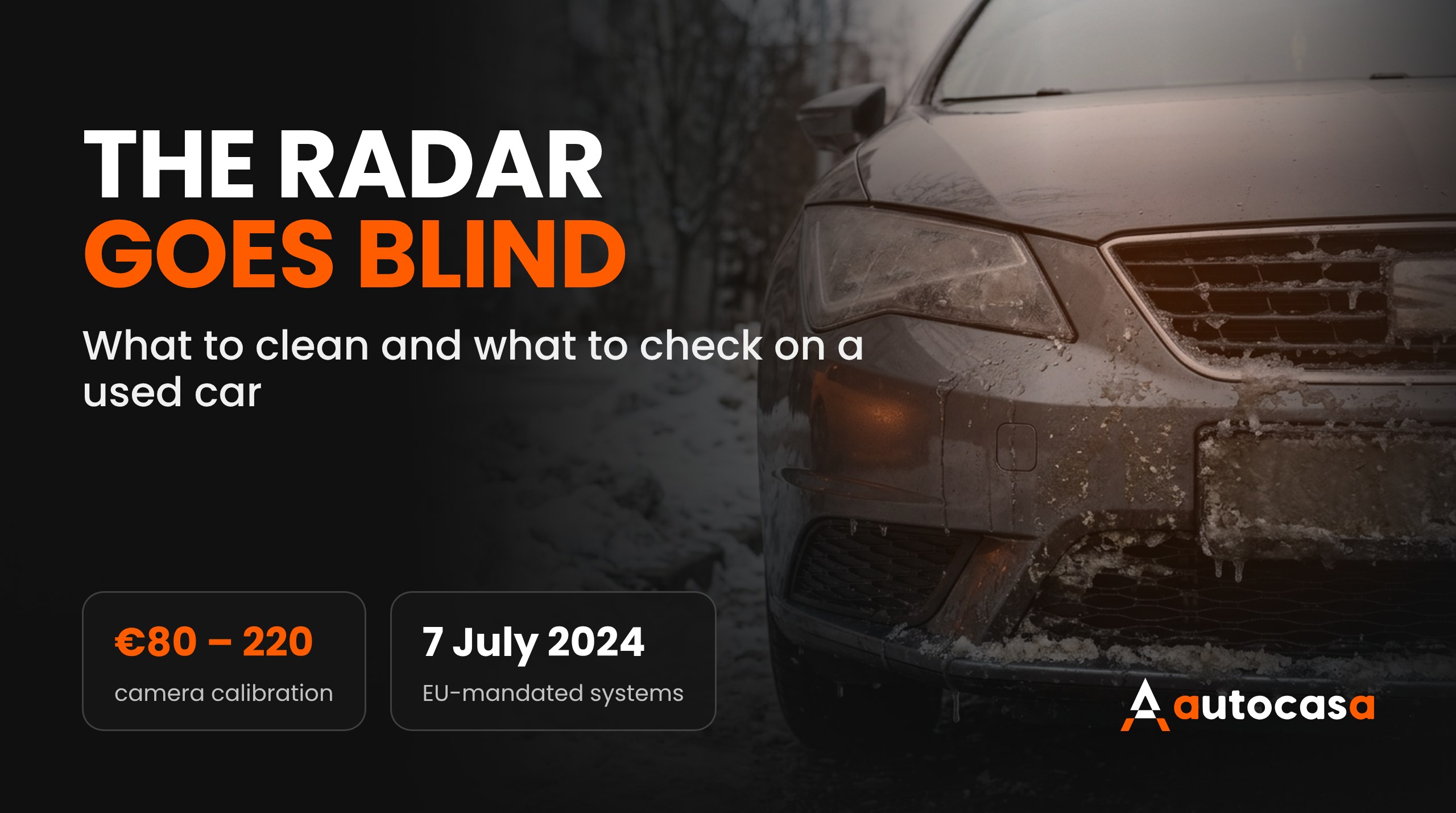
The first frosty mornings are here, and with them the warnings that catch owners of newer cars off guard every winter: adaptive cruise control switches itself off, parking sensors beep for no reason, a warning lights up on the instrument cluster. In most cases nothing is broken. The radars and cameras that almost every driver assistance system now relies on simply cannot see through a layer of snow, ice and road salt. And if you are buying a used car in Slovakia or the Czech Republic, there are costs here that many buyers never budget for.
Where the eyes of the assistance systems sit
To know what to keep clean in winter, you need to know where the sensors are. The radar for adaptive cruise control and autonomous emergency braking usually sits behind the radiator grille or inside the front bumper, sometimes directly behind the brand badge. The camera for lane keeping and traffic sign recognition is behind the windscreen next to the interior mirror. The ultrasonic sensors for parking are in the bumpers, and the cameras for the 360-degree view are in the mirrors, the grille and near the rear plate.
One simple rule applies: the lower a sensor sits above the road, the faster it gets dirty and the more often it reports nonsense. That is exactly why parking sensors in the bumper give up before the camera behind the glass, which the wipers at least partly keep clear.
Why the systems shut themselves down
The worst enemy is not snowfall but freezing drizzle. A thin sheet of ice forms on the radar cover within minutes, the system notices its accuracy dropping and prefers to deactivate itself. That is the correct behaviour: it would be far worse if it kept working with distorted data.
Just as treacherous is the film of salt and slush that builds up on the motorway within a few kilometres. In one winter test the pre-collision system of a Mercedes S-Class switched off after roughly twelve kilometres of driving in snow, and in a Jaguar the blind spot assistant quit on a wet, salted motorway and refused to come back until the sensors had been washed. Manufacturers say so plainly in their manuals: Škoda warns on the Kamiq about limited function in bad weather and with dirty sensors, Peugeot lists mud, ice and heavy rain or snow on the 508, and Lexus warns on the NX about the system even triggering unnecessarily when water or snow hits the sensors.
Hence the first rule of winter driving: do not rely on the assistance systems. Today adaptive cruise control will hold your distance; tomorrow, in the same weather, it will not engage at all.
What to clean before you drive
- Grille and bumper in front of the radar: lukewarm water and a soft cloth are enough. Never an ice scraper. The radar cover is plastic, and once scratched it reports a fault just as reliably as when it is dirty.
- Windscreen around the camera: on the inside too. A misted-up screen blinds the camera just as effectively as ice on the outside.
- Ultrasonic sensors in the bumpers: after driving in freezing rain, check them and clear the ice before you next park.
- Cameras in the mirrors and by the plate: that small lens is coated in salt within a single day.
- Wipe the sensors dry after the car wash: water left around them freezes solid at once.
- Take care parking next to high banks of ploughed snow: the sensors read them as an obstacle and can trigger automatic braking while you manoeuvre.
On a used car, calibration is a separate line item
This is the part most buyers overlook. Cameras and radars are aligned to the geometry of the vehicle, so manufacturers prescribe calibration after every windscreen replacement, after the camera or radar is replaced or removed, after repairs to the bumper or grille, after a front-end impact, after a wheel alignment, and after any suspension work that changes ride height. Wheels in a size other than the factory specification have the same effect.
Why so strict? On the front camera, an error of one millimetre produces a deviation of roughly one metre at a distance of one hundred metres. Static calibration is done in the workshop using target boards and takes one to two hours; dynamic calibration happens while driving on well-marked roads. In Slovakia the calibration itself costs roughly 80 to 220 euros, while a windscreen with an assistance camera runs from 430 to 1,300 euros. If a workshop skips the calibration after such work and does not tell the customer, it can share responsibility for the consequences, because a departure from the manufacturer’s procedure can be proven.
Cars from July 2024 have these systems by law
The European Union’s General Safety Regulation (2019/2144) has applied to new vehicle types since July 2022 and to all new vehicles sold in the EU since 7 July 2024. Mandatory items include intelligent speed assistance, cameras or sensors for reversing detection, driver drowsiness and attention warning, the emergency stop signal, and — on cars and vans — lane keeping systems, automated emergency braking and event data recorders.
In practice that means every used car from 2024 onwards will have these systems, and you need to try them during the inspection. On the test drive switch on the cruise control and the lane assistant, watch for any error messages, and ask the seller directly whether the windscreen has been replaced and whether calibration followed. A workshop invoice is the best possible answer.
How to word it in the advert
If you are the one selling, working electronics is a selling point. State in the advert which assistance systems the car has, whether the windscreen was replaced and whether you hold proof of calibration. You will save yourself the same questions at every viewing, and the buyer has a reason to trust you.
Listing on AutoCasa is free, with no sales commission and no limit on the number of adverts. Promoting a listing is optional and starts at 1.50 euros. Besides cars you will find motorcycles, vans and trucks, buses, trailers, spare parts, wheels and tyres, and bicycles here as well, so the spare set of wheels left in your garage after the tyre change has somewhere to go.
The information on mandatory equipment is based on Regulation (EU) 2019/2144 of the European Parliament and of the Council as in force in November 2026. The prices quoted are indicative market prices at Slovak workshops and may vary by model and region.



 Slovenčina
 Čeština
 Angličtina
 Nemčina
 Poľština
 Slovinčina
 Ruština
 Taliančina
 Maďarčina
 Francúzština


Zatiaľ tu nie sú žiadne komentáre. Buďte prvý!