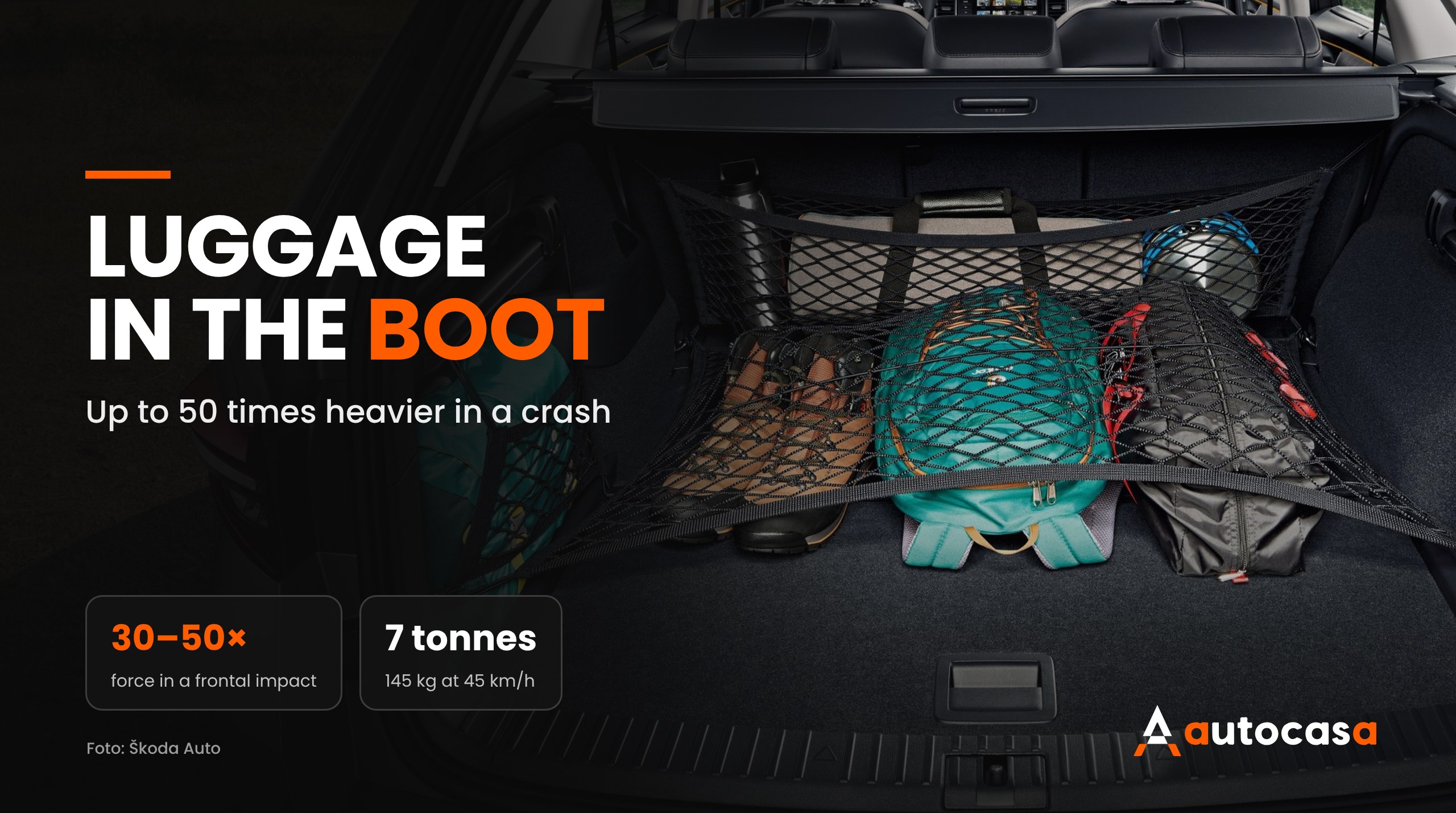
Christmas shopping, presents, skis and the drive to the mountains – in December the boot is fuller than at any other time of year. Few drivers realise that a bag of presents turns into a projectile in a crash. In crash tests, the German automobile club ADAC found that loose objects strike the occupants with thirty to fifty times their own weight. The good news: loading a car safely takes a few minutes and no expensive equipment.
Ten kilograms that hit like half a tonne
The physics here is brutally simple: anything that is not attached to the car keeps moving at the original speed when the car stops. When a car hits a solid obstacle at 50 km/h, the body deforms and comes to rest in a fraction of a second. The suitcase with the ski boots does not.
According to ADAC, in a frontal impact loosely packed items act on the occupants with a force equal to 30 to 50 times their mass. A ten-kilogram bag therefore hits the seat back and the passenger’s head with several hundred kilograms of force. In one of the club’s tests, 145 kilograms of unsecured load pulled on the seat belts with more than seven tonnes in a 45 km/h impact.
The treacherous items are the small ones: the thermos on the back seat, the glass wine bottle, the tool box or the metal baking tin. During normal braking you never notice them; in a crash they decide whether you walk away with a bruise or with concussion.
What goes where: heavy low and forward
The key rule is simple: heavy items on the boot floor, right up against the backs of the rear seats. There they have the shortest run-up, and the seat back stands in their way. Light and soft things belong higher up and closer to the tailgate.
If nobody is sitting in the back and the boot is loaded high, fasten the rear seat belts. The seat back then copes much better with the pressure of the load. This applies to belts anchored to the body, not to the backrest itself; if the centre belt comes down from the roof, use that one too.
The parcel shelf is not a shelf for hard objects. A bottle, a book, an umbrella or a lunch box will end up in the cabin at the first hard braking. Soft items – a cushion, a small blanket, a foam mat – are acceptable, ideally behind the head restraints.
What the rules require in Slovakia and Czechia
If you drive in Slovakia or Czechia, or buy a car there, it pays to know the local rules. In Slovakia, § 51 of Road Traffic Act No. 8/2009 Z. z. requires the load to be correctly placed, distributed and secured so that it does not endanger traffic and does not shift or fall during braking or in a bend. The maximum permissible mass of the vehicle and the axle loads must not be exceeded either.
In Czechia, the same subject is covered by § 52 of Act No. 361/2000 Sb.: objects in the vehicle must not restrict or endanger the driver and passengers, must not block the driver’s view, and the load must be secured so that it does not compromise safety. These are Slovak and Czech rules – other countries have their own regulations, although the principle is the same.
Skis, snowboards and Christmas presents
- Skis and snowboards belong in a roof box. If they travel inside, strap them together and lash them to the lashing eyes in the floor rather than laying them loose on folded seats.
- Ski boots fit in the footwell behind a front seat: low down and out of the flight path.
- Glass bottles should be wrapped or swapped for plastic. In a crash they produce sharp fragments.
- Put small items in boxes. One sturdy carton behaves far better under braking than fifteen carrier bags.
- Load the roof box sensibly: roughly half the weight between the bars, a quarter at the front and a quarter at the rear. The maximum roof load is in the vehicle documents and includes the weight of the bars and the box itself.
- Keep the first-aid kit and warning triangle within reach, not buried under luggage at the bottom of the boot.
What to secure the load with – and what not to
Elastic bungee cords are not enough to secure a load. In a crash they stretch, slip off and let the load go. Use lashing straps with a stated rated capacity and run them diagonally through the eyes in the boot floor. Throw a blanket over the load: it spreads the pressure of the straps and hides the contents from passers-by at the same time.
If the car has a separating net or grille, use it whenever the load rises above the seat backs. A net tensioned all the way to the headlining is far more useful on the way to the mountains than the luggage cover alone, which holds nothing back.
On a used car it is worth checking that the lashing eyes in the boot floor are intact and that the original net and luggage cover are present. Missing parts can be bought later, but it is better to know about them before the purchase than while packing for a ski trip.
Whatever you no longer use, pass it on
Before you set off, spend five minutes on a simple check: heavy items low, nothing hard loose in the cabin, straps tensioned, roof box and carrier tightened. It is the cheapest safety system your car has.
And if an old roof box, a bike carrier or a set of straps you no longer use is taking up space in the garage, offer them to other drivers on AutoCasa. Listings are free, with no sales commission and no limit on the number of adverts. Besides cars, motorcycles, vans, trucks, buses and trailers, the portal also has categories for spare parts, wheels and tyres, and bicycles. Promoting a listing is optional and starts at 1.50 €.
If, on the other hand, you are still looking for a roof box or a carrier before the ski season, a used one at a fraction of the new price is often exactly what an overloaded family boot needs.
The information in this article is based on Slovak Act No. 8/2009 Z. z. and Czech Act No. 361/2000 Sb. as in force on 22 November 2026, and on crash tests by the German automobile club ADAC. Other countries may have different rules.


 Slovenčina
 Čeština
 Angličtina
 Nemčina
 Poľština
 Slovinčina
 Ruština
 Taliančina
 Maďarčina
 Francúzština


Zatiaľ tu nie sú žiadne komentáre. Buďte prvý!