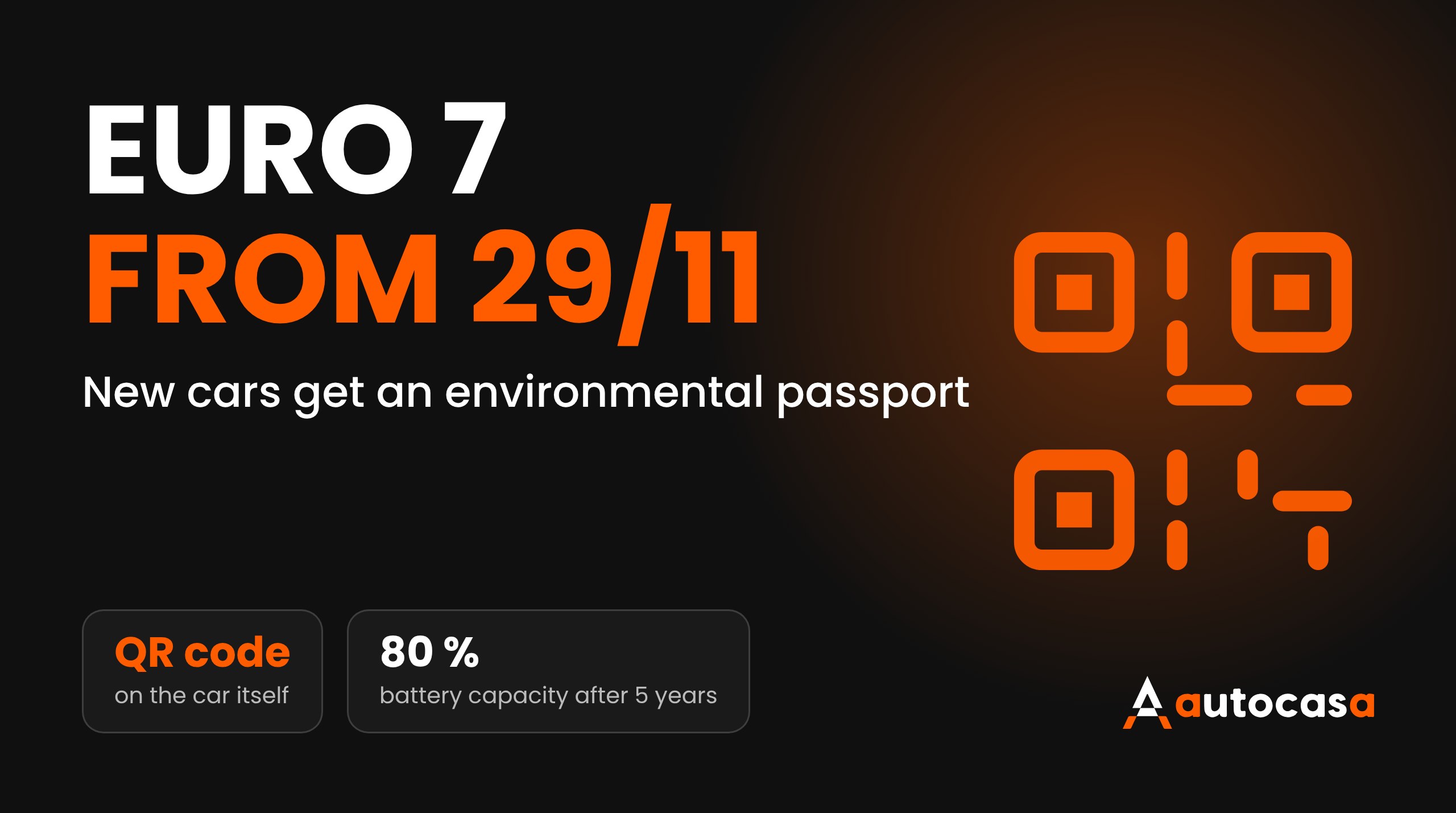
From 29 November 2026, new types of passenger cars and light commercial vehicles must meet the Euro 7 emissions standard. With it comes a document most drivers have never heard of: the vehicle environmental passport, reachable through a QR code fixed to the car itself. The good news is that anyone already driving has nothing to arrange at any office. The less good news is that new cars will probably get more expensive, and that in a few years used-car buyers will be reading an entirely new set of figures.
What exactly starts on 29 November
Euro 7 was introduced by Regulation (EU) 2024/1257 of the European Parliament and of the Council, replacing Euro 6. It arrives in two steps: from 29 November 2026 the standard applies to new types of passenger cars and light commercial vehicles (categories M1 and N1) approved for the European market. From 29 November 2027 it will cover every new vehicle in those categories placed on sale and registered. Trucks and buses follow later.
This is EU legislation, so it applies across the Union, including in Slovakia and the Czech Republic, where AutoCasa operates. What matters most for drivers is that the tailpipe limits for petrol and diesel cars are essentially carried over from Euro 6. The real changes sit elsewhere: longer guaranteed durability, the first limits on brake dust, requirements for the traction battery, and digital transparency.
The environmental passport: a QR code on the body
The environmental passport is not a card for the glovebox. It is a digital record tied to one specific vehicle, and the manufacturer has to provide it. A QR code will be fixed permanently and visibly to the vehicle, or the on-board system can display the passport — under implementing Regulation (EU) 2025/1707, no more than five menu levels deep. The code opens a vehicle page that may ask for the VIN. Access must not require registration or any special software, and the manufacturer has to keep the data for at least 20 years after the car is built.
The passport holds the make and model, VIN, date of manufacture and approval data, maximum engine power, pollutant limits, CO2 emissions, fuel or electricity consumption under WLTP, and electric range. One important point: the environmental passport does not replace the registration certificate. The paperwork you have to carry does not change on 29 November.
First limits for brake dust, tyres still waiting
Until now, type approval measured almost nothing but exhaust emissions. Euro 7 is the first standard to cover what a car releases away from the tailpipe as well. For brake particles (PM10) the limit until the end of 2029 is 3 mg/km for battery electric cars and 7 mg/km for all other powertrains in passenger cars and light vans. For the heaviest N1 class III vans the figures are 5 and 11 mg/km. Limits are due to tighten from 2030, and from 2035 3 mg/km is foreseen regardless of powertrain.
For tyres, Euro 7 so far sets only a framework. The actual abrasion limits and the test method are still being worked out in a UNECE working group, and for C1 tyres — the ones fitted to cars — the start is not expected before 2028. No binding tyre abrasion limit applies today.
The battery: no more guesswork on a used EV
This is the change the used-car market will feel most. Euro 7 extends the period in which a vehicle must stay within its emission limits to 200,000 km or 10 years, roughly double Euro 6. And for the first time it sets a minimum life for the traction battery.
- Passenger cars (M1): after 5 years or 100,000 km the battery must retain at least 80 % of its usable capacity, and at least 72 % after 8 years or 160,000 km.
- Light commercial vehicles (N1): the same milestones, with thresholds of 75 % and 67 %.
- The car has to show it itself: the vehicle displays the SOCE value, the remaining usable battery energy compared with the certified new state, plus current and long-term consumption.
- From 18 February 2027 a digital battery passport follows under Regulation (EU) 2023/1542, covering origin, composition and carbon footprint.
In practice, anyone buying a used electric car with Euro 7 approval in four or five years will read the battery’s condition straight off the screen — no guessing, no paid workshop diagnosis. That does not apply to older EVs, where having the battery state checked before you pay remains one of the most important things to do.
What it means for your car and your wallet
- There is nothing to arrange. Euro 7 is an approval standard for new vehicles, not an obligation for cars already on the road.
- Used cars get no passport retroactively. Vehicles approved before the standard takes effect stay without an environmental passport for good.
- New cars may cost more. The European Commission estimates roughly 90 to 150 € per car; an earlier Commission impact assessment for cars and vans put it at 180 to 450 €. Industry, working from the original stricter draft, talked about around 2,000 €. The adopted text is milder.
- Small, cheap cars feel it most. On pricier models and on EVs with regenerative braking the effect is smaller.
- „Buy before prices rise“ is not a universal rule. It depends on the model and on when it goes through a new approval.
How to use it when selling and buying
The emissions standard is a detail buyers care about more and more, especially when importing a car or driving into a low-emission zone. If you are selling, find it on the registration certificate and put it straight into the listing. For a used EV or plug-in hybrid, add whatever you know about the battery: a measured state of health, or a workshop report. A transparent listing saves both sides phone calls and pointless viewings.
On AutoCasa, posting a listing is free, with no sales commission and no cap on the number of listings; promoting one is optional and starts at 1.50 €. You can list cars, motorcycles, vans and trucks, buses, trailers, spare parts, wheels and tyres, and bicycles. And if you are looking for a car in Slovakia or the Czech Republic, browse the offer on AutoCasa.sk — vehicles approved to Euro 6 will be on the used market for many years yet and, at the right price, remain a good buy.
This article is based on Regulation (EU) 2024/1257 (Euro 7), implementing Regulation (EU) 2025/1707 and Regulation (EU) 2023/1542 on batteries, as known on 7 November 2026. Tyre abrasion limits and the tighter brake dust limits after 2029 are still being finalised.


 Slovenčina
 Čeština
 Angličtina
 Nemčina
 Poľština
 Slovinčina
 Ruština
 Taliančina
 Maďarčina
 Francúzština


Zatiaľ tu nie sú žiadne komentáre. Buďte prvý!