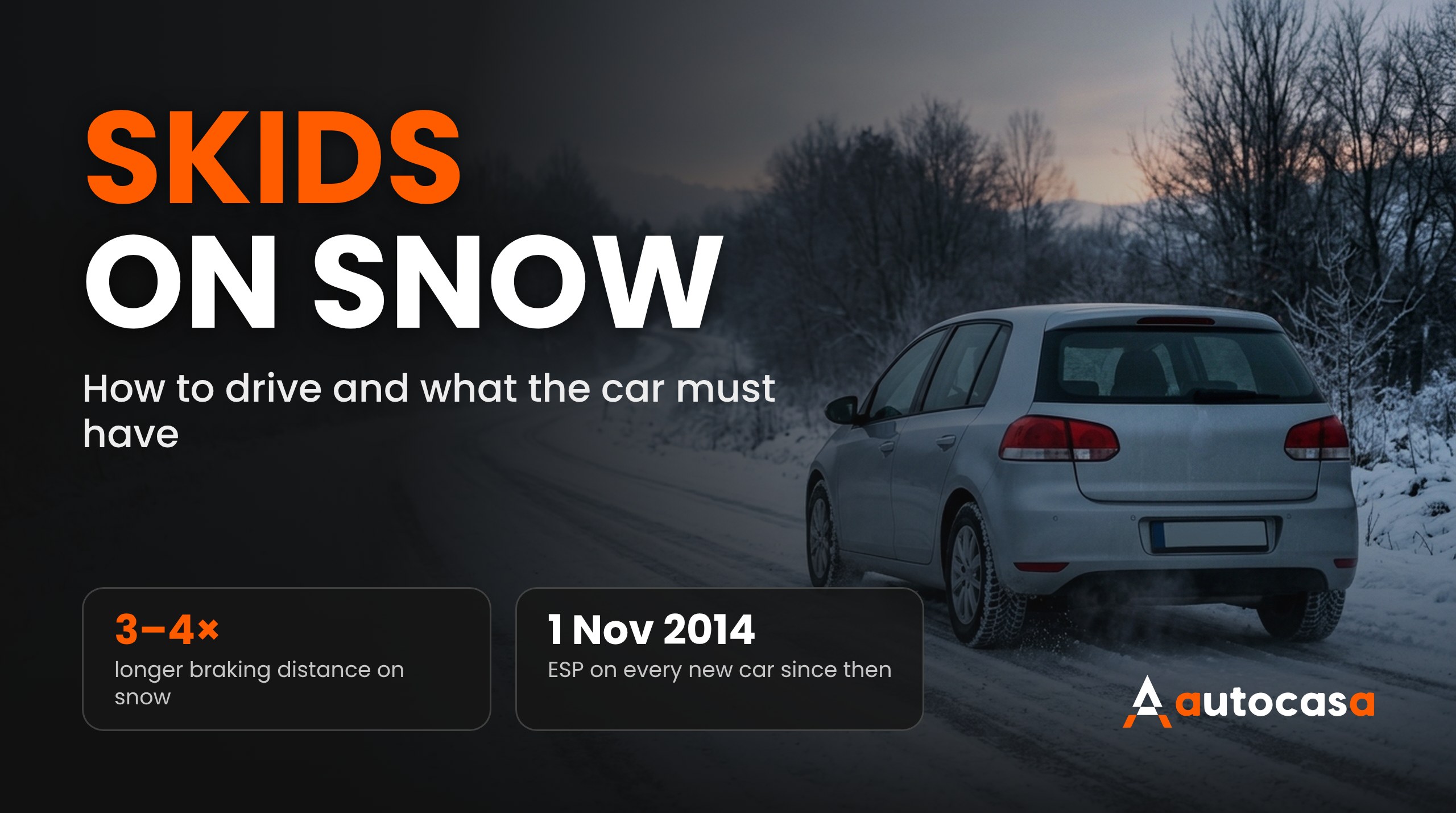
In Slovakia and Czechia the first real snowfall usually catches drivers out in the morning, on the way to work. The car suddenly behaves differently: the brakes don’t bite the way you expect, and the rear wants to swing wide in a bend. Most of the trouble is settled by what you do before the slide even starts. And on an older used car it pays to know whether the electronics that can catch you are actually there.
What snow does to your braking distance
On a snow-covered road the braking distance is roughly three to four times longer than on dry asphalt. On ice it stretches to five to ten times. These are not abstract numbers: if you stop from 60 km/h in two car lengths on dry tarmac, on black ice you will need considerably more than a whole intersection.
Hence the first rule of winter: following distance. Double the two-second gap you were taught in driving school. Pick a fixed point by the road – a pole, a sign, a bridge – and count how long it takes you to reach it after the car ahead. Four seconds is not excessive caution; it is the room you need to stop.
Pulling away, braking, cornering: keep it smooth
On snow you have a limited amount of grip, and every abrupt movement of the wheel or a pedal spends it all at once. One simple rule covers most of it: brake while you are going straight, and steer when you are not braking.
- Pulling away: feed in the throttle gently. With a manual gearbox, starting in second helps – the engine delivers less torque and the wheels don’t spin.
- Braking: brake earlier and for longer rather than harder at the last moment. Slow down before the bend, not in it.
- Cornering: enter more slowly than your summer instinct suggests and hold a steady throttle all the way through.
- Descents: select a lower gear and let the engine do the braking. On an automatic, use manual mode or the position that forces a downshift.
- Surface: a shiny patch is almost always ice. Packed ruts are slipperier than the soft snow beside them – if the road is wide enough, drive on that instead.
- Visibility: clear the snow off the whole car, roof and headlights included. LED units give off almost no heat and will not melt the ice on their own.
What ABS and ESP do for you
ABS stops the wheels locking under braking. The control unit assesses the situation roughly every five milliseconds, so in the time of a single blink it intervenes many times over. When you feel the pedal pulsing underfoot and hear a growl, ABS is working – do not release the brake. Keep it pressed and steer around the obstacle.
ESP (ESC, DSC, VSA or VSC depending on the brand) goes a step further. It compares where you are pointing the steering wheel with where the car is actually going. When the two diverge, it brakes individual wheels and cuts engine power until the car is back on line. On snow that is the difference between a correction you barely notice and a spin in a bend.
Does that used car have ESP? The build year decides
ESP is not a given on every car driving around Slovakia and Czechia today. It became mandatory in stages: under Regulation (EC) No 661/2009 it was required on new vehicle types from 1 November 2011 and on all new vehicles sold in the EU from 1 November 2014. Cars built before that may have it, but they need not – it was often a cost option on higher trim levels.
On the used market that matters. The average age of the Slovak vehicle fleet in the first quarter of 2026 was about 15 years, and in Czechia the average age of passenger cars reached 16.68 years in December 2025. The typical car on these markets therefore comes from a time when ESP was not yet compulsory. Retrofitting it is effectively impossible: it needs its own hydraulic unit, wheel speed sensors, a steering angle sensor and a lateral acceleration sensor.
How to check during a viewing:
- With the ignition on, every warning lamp lights up briefly in the instrument cluster, including the symbol of a car with skid marks. If that lamp is not there at all, the car has no ESP.
- If the lamp does not go out after starting, the system is reporting a fault – usually a wheel speed sensor or the steering angle sensor. Have the fault codes read out.
- Look for the ESP off button, normally on the centre console. Its presence is a good sign; its absence alone proves nothing.
- For the specific car, check via the VIN or the equipment code whether ESP was fitted. On models from 2005 – 2013 it varies from one example to the next.
Electronics are no substitute for tyres
ESP can divide up the available grip more intelligently, but it cannot create it. When there is nothing under the car to put down on the road, even the best electronics will not help. Bear in mind that in Slovakia winter tyres on a passenger car must have at least 3 mm of tread and are compulsory whenever the road is covered by a continuous layer of snow, ice or frost. In Czechia the minimum is 4 mm between 1 November and 31 March. These are Slovak and Czech rules – if you are driving on, check the regulations of your destination country.
It works the other way round too: new winter tyres on a car without ESP are still a far better investment than the opposite combination.
If you are shopping for a winter car
If you are looking for a car that has to survive a Central European winter, put ESP on the list right next to the condition of the tyres, the battery and the heater. On vehicles from 2015 onwards it is guaranteed; on older ones, ask the seller directly and check the lamp in the instrument cluster.
On AutoCasa you will find used cars, motorcycles, vans and trucks, buses, trailers, spare parts, wheels and tyres and bicycles from Slovakia and Czechia. Listing is free and with no sales commission, and promoting a listing is optional, starting at 1.50 €.
And if you are selling, spell the equipment out. „ESP, heated seats, winter tyres with 6 mm of tread“ tells a buyer far more than a vague „well equipped“, and saves you dozens of questions in your inbox.
The information in this article is based on Slovak Act No. 8/2009 Z. z. on road traffic, Czech Act No. 361/2000 Sb. and Regulation (EC) No 661/2009 as in force in November 2026. The braking distance figures are indicative and depend on the road surface, the tyres and the vehicle.


 Slovenčina
 Čeština
 Angličtina
 Nemčina
 Poľština
 Slovinčina
 Ruština
 Taliančina
 Maďarčina
 Francúzština


Zatiaľ tu nie sú žiadne komentáre. Buďte prvý!