The first properly frosty morning usually arrives without warning, and with it the most common autumn breakdown: you turn the key and the starter just groans. A flat battery is not an expensive repair in itself. What tends to get expensive is what drivers do next – clamps on the wrong terminals, bump-starting a modern car, or a tow that wrecks the gearbox. Here is the sequence that works, and the list of things not to do in the cold.
Why the battery gives up at the first frost
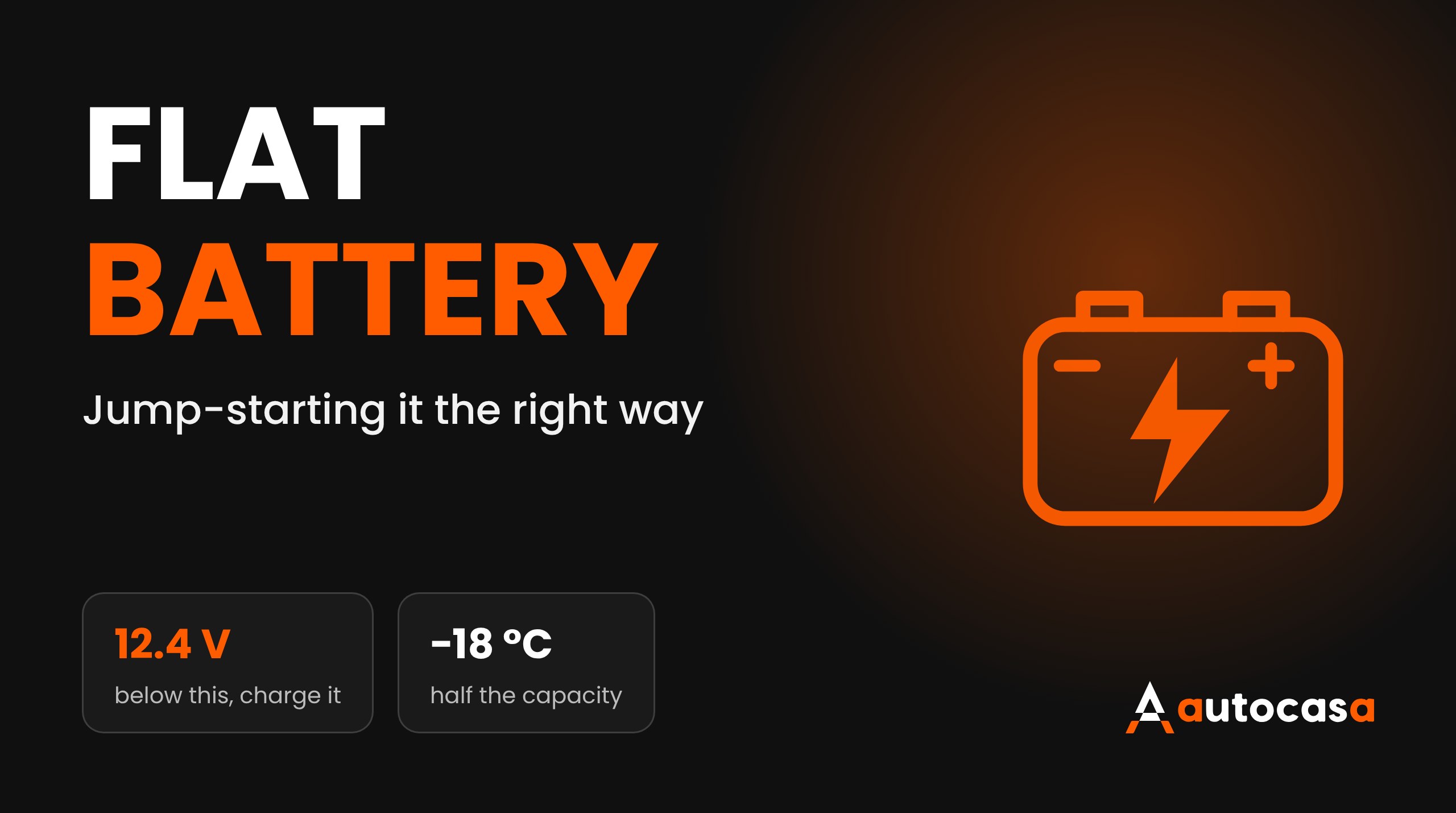
A lead-acid battery does not behave linearly in the cold. At 0 °C it has roughly 80 % of its rated capacity available, at −18 °C only about half. At the same time a cold engine puts up more resistance: thicker oil means the starter draws more current than it does in summer. The two effects pull against each other – the battery delivers less while the engine asks for more.
That is exactly why the battery that „still pulled fine“ in September will not start the car in November. A reliable health check takes an ordinary multimeter: a resting voltage below 12.4 V means the battery needs charging. If it drops back to the same reading after every long drive, it is at the end of its life and charging only postpones the problem.
Before you reach for the jumper cables
- The battery must not be frozen. If it is frozen or the electrolyte level is low, do not jump-start it from another car – it can crack or explode.
- An equally strong donor. The battery in the helping car should have the same or a higher capacity than the flat one.
- 12 V only. Jump-starting from a 24-volt system, a truck for instance, can permanently destroy a 12-volt starter motor.
- Everything switched off. In both cars turn off the lights, heating, heated seats and radio. They draw the current the starter now needs.
- No open flame. Batteries can release hydrogen. The spark made by the final clamp is the reason that clamp goes well away from the battery.
The right order of the clamps, step by step
- Connect the red cable to the positive terminal of the flat battery, then the other end to the positive terminal of the donor battery.
- Connect the black cable to the negative terminal of the donor battery.
- The other end of the black cable does not go on the negative terminal of the flat battery, but on unpainted metal on the engine or body, away from the battery. Negative to negative can overheat the flat battery, rupture it and let acid leak out.
- Start the helping car, let it run for a few minutes and raise the revs slightly. Only then try to start the car with the flat battery.
- If the first attempt fails, wait 10 to 15 minutes and try again. Cranking without a break only overheats the starter.
- Disconnect in reverse order: the earth point on the flat car first, then negative and positive on the donor battery, and the positive on the flat battery last.
In many newer cars the battery sits under a cover in the boot or beneath a seat, and the engine bay has dedicated jump-start points instead – a red cap for positive and a marked earth point. Use them; they are shown in the owner’s manual and they exist for exactly this situation. A portable jump starter does not change the procedure, it only replaces the second car – the order of the clamps stays the same.
Do not switch the engine off straight after it starts
The alternator is not a charger. For the battery to become usable again it needs at least half an hour of driving, ideally 50 to 100 kilometres in one go. The short run to work and back, by contrast, is the surest way to end up in the same place the next morning: after a start, more energy has to go back into the battery than the starter took out of it.
If the car stands for longer, a mains charger is the sensible answer. On a simple charger the current is kept at around one tenth of the battery’s capacity, a frozen battery is not charged at all, it should not stay on the charger for more than ten hours, and AGM or gel batteries need the appropriate mode.
Bump-starting and towing: when it is a bad idea
Bump-starting worked on older cars. On a modern vehicle it pushes unburnt fuel into the exhaust and can damage the catalytic converter – the repair then costs several times a new battery. Torque-converter automatics can be towed only within narrow limits (around 50 km/h and 30 kilometres are the figures usually quoted), dual-clutch, CVT and automated manual gearboxes are unsuitable for towing, and electric cars and plug-in hybrids are not rope-towed at all – they belong on a flatbed.
Driver assistance systems are worth a thought too: with the ignition on, the emergency braking radar can read the towing vehicle as an obstacle and start braking. Switch those systems off before you set off.
If the tow happens in Slovakia or the Czech Republic, these rules apply – they cover Slovakia and the Czech Republic, not your own country:
- A maximum of 60 km/h.
- The gap between the vehicles must be no more than 6 m; at least 2.5 m with a rope, at least 1 m with a rigid bar.
- The rope must carry a red flag or plate, the bar alternating red and white transverse stripes.
- The towed car must have working steering. Without effective brakes only a rigid bar is allowed; without working steering towing is not permitted at all.
- On a motorway towing is allowed only to remove the vehicle, and only as far as the nearest exit.
- Put a warning triangle in the rear window of the towed car. Leave the hazard lights off – you need the indicators.
- Towing several vehicles in a row, or a car that is itself pulling a trailer, is prohibited.
When viewing a used car, insist on a cold start
For a buyer this season is an advantage. A car the seller warms up before you arrive hides a weak battery, a worn starter and glow-plug trouble. Arrange the viewing so that you are there for the first start of the day, and look at the battery itself: the production date on the label, clean and unoxidised terminals, a firm mounting.
If you are the one left with a working battery, a charger or a set of jumper cables from a previous car, you can list them on AutoCasa under spare parts. Listings are free, with no sales commission and no limit on how many you post; promotion is optional and starts at 1.50 €. Alongside parts you will find cars, motorcycles, vans and trucks, buses, trailers, wheels and tyres, and bicycles.
The towing rules in this article come from Slovak Act No. 8/2009 Z. z. on road traffic and Czech Act No. 361/2000 Sb., as in force in October 2026, and apply in Slovakia and the Czech Republic. Check the jump-start procedure in your own vehicle’s manual – the manufacturer may specify its own jump points and restrictions.


 Slovenčina
 Čeština
 Angličtina
 Nemčina
 Poľština
 Slovinčina
 Ruština
 Taliančina
 Maďarčina
 Francúzština


Zatiaľ tu nie sú žiadne komentáre. Buďte prvý!