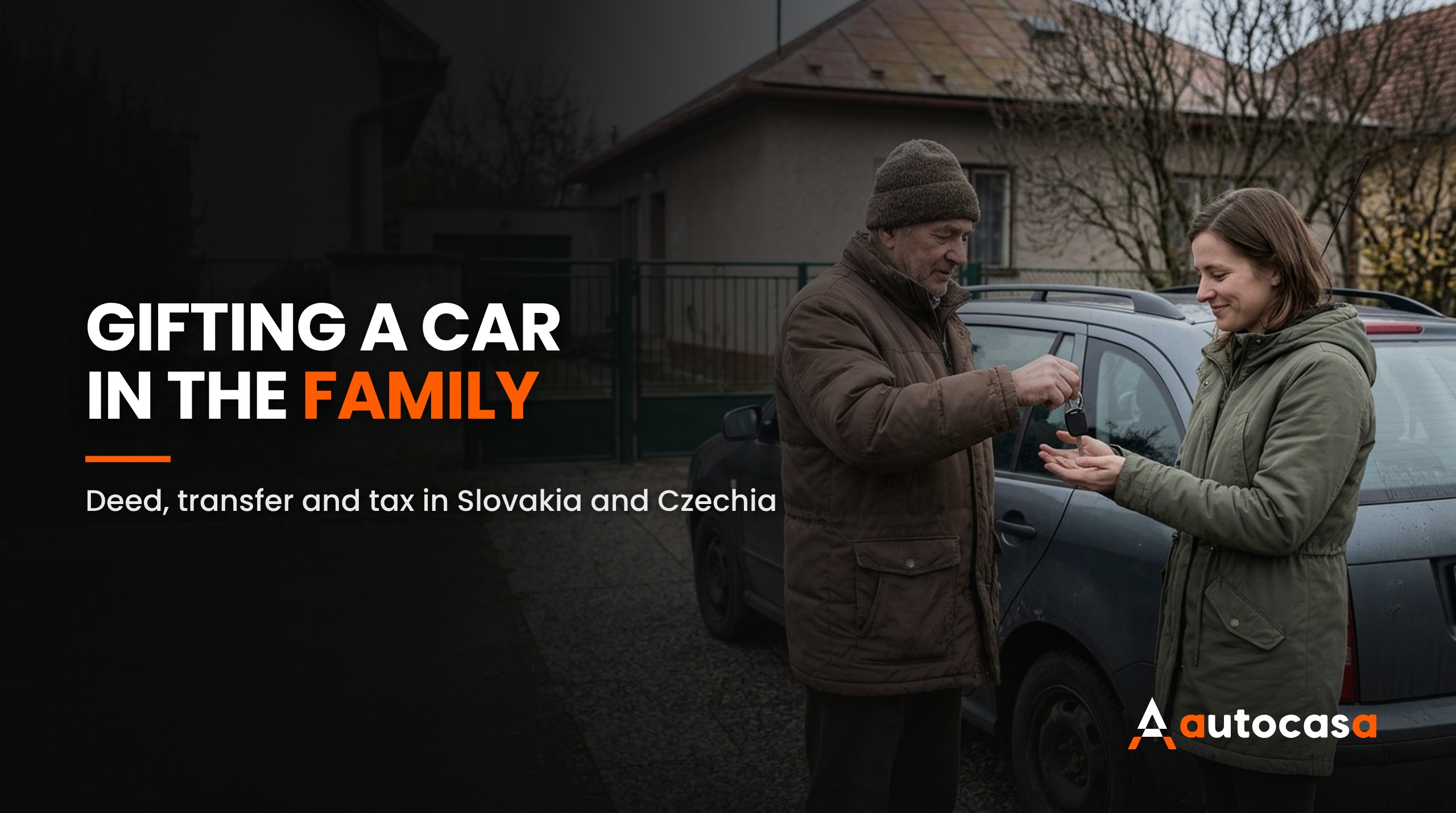
Cars change hands within families all the time: a daughter gets her father’s old estate car, a son takes over his grandfather’s motorbike, a couple puts the second car in one spouse’s name. If the vehicle is registered in Slovakia or the Czech Republic, one thing is worth knowing: a gift is not the same as a sale for a symbolic euro. Here is what the deed must contain, which deadlines apply, what the transfer costs and when tax is due.
The deed of gift: a sheet of paper and two signatures
If the car is handed over at the moment of signing, neither Slovak nor Czech law requires a written contract. The registration office, however, will ask you to prove how you acquired the vehicle, and the deed of gift is that proof. Without it the transfer will not go through.
Notarised signatures are not required for the deed itself. You will only need a certified signature if one of the parties is represented at the office by someone else under a power of attorney.
- Donor and recipient: name, address, date of birth, ID document number.
- Vehicle: make, model, year of manufacture, VIN, registration plate and the number of the registration certificate.
- A clear sentence about it being free of charge: the donor transfers the vehicle at no cost and the recipient accepts the gift. The text must make clear this is not a sale.
- Date and place of handover of the car, the documents and the keys.
- Condition of the vehicle: a sentence confirming the recipient knows the technical condition and any damage. With a gift, liability for defects is judged differently than in a sale.
Deadlines: 30 days in Slovakia, 10 working days in the Czech Republic
In Slovakia the change of registered holder has to be reported within 30 days of the day it happened. Under § 116 of Act No. 8/2009 Z. z. on road traffic the duty lies with the previous holder, meaning the donor. The old two-step deregistration and re-registration is gone: today it is handled in a single step at any traffic inspectorate in the country.
In the Czech Republic the deadline is much shorter. The application to register the change of owner must be filed within 10 working days of the transfer of ownership (§ 8 of Act No. 56/2001 Sb.). Missing it can cost a private individual a fine of up to CZK 50,000. Donor and recipient file together at the same office, although not necessarily at the same time.
What the transfer costs
In Slovakia, since 1 July 2023 the administrative fee for registering the holder is calculated from engine power in kW and then multiplied by an environmental coefficient based on the emission class. Rates start at 33 euros for engines up to 80 kW and reach 1,000 euros from 210 kW upwards. Electric cars pay a flat 33 euros. The age of the vehicle no longer matters.
The coefficient favours cleaner cars: 0.40 for Euro 6d and newer, 0.50 for Euro 5, 0.60 for Euro 4, 0.10 above 40 years old, and 0.20 for hydrogen and plug-in hybrids. Filing electronically cuts the fee by 50 percent, capped at 50 euros. Inheritance and the settlement of marital joint property are exempt from the fee, a gift is not.
The Czech side is simpler: CZK 800 for a passenger car, or CZK 640 if you file the electronic form through the transport portal. On top of that comes the environmental levy that the new owner pays for vehicles below the Euro 3 standard: CZK 3,000 for Euro 2, CZK 5,000 for Euro 1 and CZK 10,000 for anything older. Good news for families: transfers between close relatives are exempt from that levy.
Tax: none in Slovakia, a question of family ties in the Czech Republic
Slovakia has no separate gift tax, and income acquired by gift is not subject to income tax under § 3 (2) (a) of Act No. 595/2003 Z. z. Neither the value of the car nor the family relationship makes any difference: a private individual who receives a car as a gift pays nothing and declares nothing.
The Czech Republic abolished gift tax in 2014, but a gift is now treated as gratuitous income under § 10 of Act No. 586/1992 Sb. Relatives in the direct and collateral line are exempt, as is a person who lived with the donor in a shared household for at least a year. From anyone else, a gift is exempt only up to CZK 50,000 per donor per tax period. Above that, the full value is taxed at 15 percent, or 23 percent for high incomes.
The same exception applies in both countries: a gift connected with employment or business is taxable. If a company gives a car to an employee, or a sole trader puts the car into business assets, it is worth a conversation with an accountant.
What people forget most often
- Arrange third-party liability insurance before going to the office. In Slovakia the new holder has to present proof of insurance at the transfer itself; the donor’s policy does not carry over.
- Check that the roadworthiness and emissions tests are still valid. On a car that sat in the family for years these dates are easy to miss.
- Make sure there is no lien on the vehicle and that it is not under a lease. You can only give away what the donor actually owns.
- The motorway vignette is tied to the registration plate in both countries. If the plate stays the same, the vignette remains valid.
When nobody in the family needs the car
Sometimes the maths shows the family’s second car is no use to anyone any more. In that case list it on AutoCasa. Listings are free, with no commission on the sale and no limit on how many you post; promoting a listing is optional and starts at 1.50 euros. You can add cars, motorbikes, vans and trucks, buses, trailers, spare parts, wheels and tyres, and bicycles.
Say in the listing that the car stayed in one family for years, and add the service history and real mileage. These are the cars buyers look for, and one honest description saves dozens of phone calls.
The information in this article applies to vehicles registered in Slovakia and the Czech Republic and is based on Slovak Acts No. 8/2009 Z. z., No. 145/1995 Z. z. and No. 595/2003 Z. z., and Czech Acts No. 56/2001 Sb., No. 634/2004 Sb., No. 542/2020 Sb. and No. 586/1992 Sb., as in force in November 2026. These are not the rules of other countries. For a specific case, consult an accountant or a lawyer.


 Slovenčina
 Čeština
 Angličtina
 Nemčina
 Poľština
 Slovinčina
 Ruština
 Taliančina
 Maďarčina
 Francúzština


Zatiaľ tu nie sú žiadne komentáre. Buďte prvý!