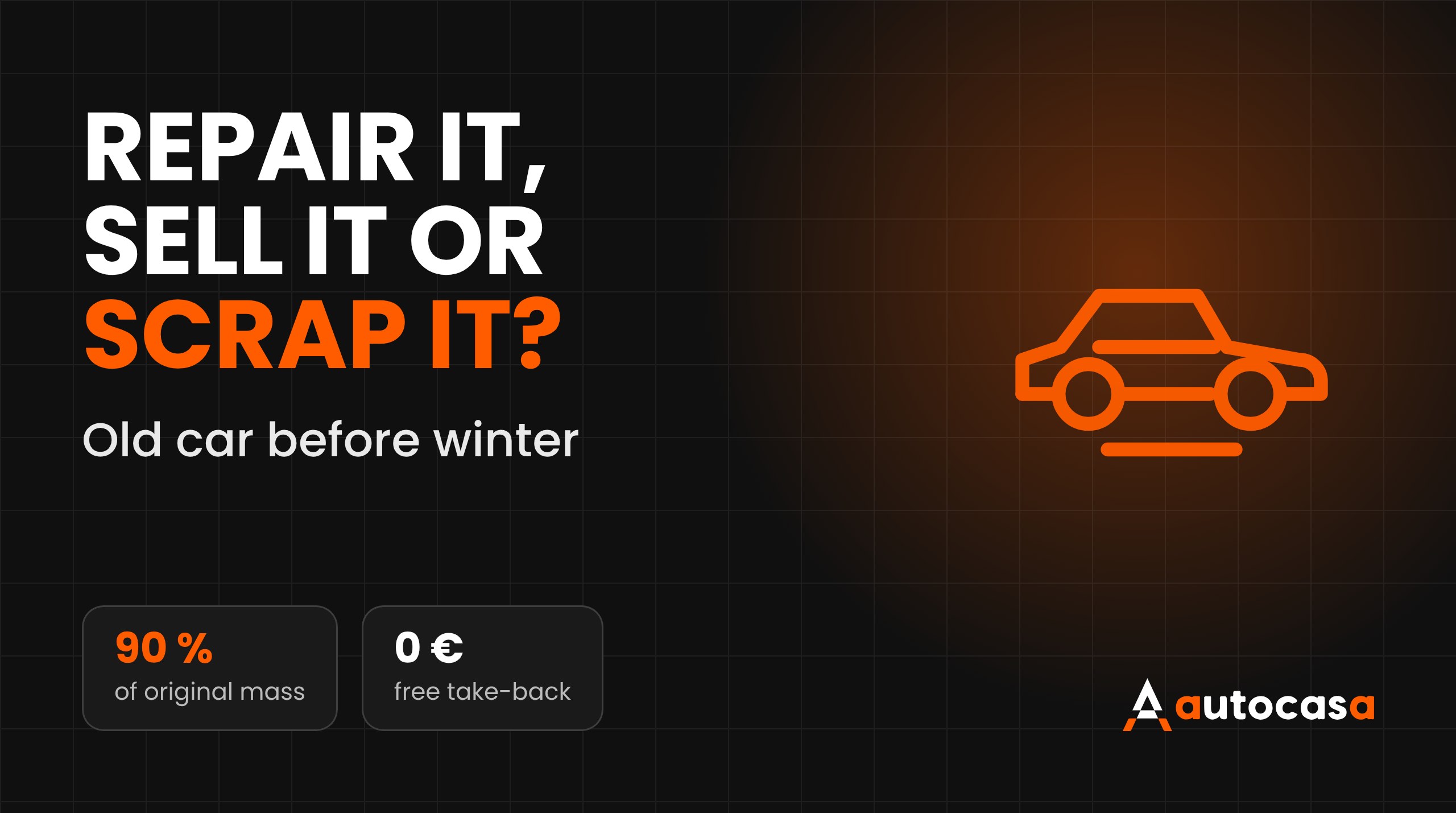
The first frosts and a roadworthiness test coming due can turn an old car into a problem overnight. When the repair estimate is higher than the amount the vehicle could still be sold for, the awkward question arrives: repair it, sell it, or have it scrapped? For a car registered in Slovakia or the Czech Republic, each of those routes means different paperwork, different deadlines and a different hit to your wallet.
When repairs stop paying off
There is no universal formula, but a simple comparison works in practice. Add up the repairs the car will need over the coming year – not just what is broken today – and set that against the realistic price the same model with similar mileage actually sells for. If the repair bill approaches half that price, the other options deserve a look.
What matters more than the figure is the type of damage. A clutch, shock absorbers or a timing belt are ordinary investments that carry a car years further. A rotted-through structural sill or a chassis rail is a different league: corrosion of load-bearing parts is among the most common reasons a vehicle fails its technical inspection, and the repair is slow and expensive. Road salt speeds that up every winter.
Selling the whole car is usually the sensible first move
Even a car that no longer runs has a value: a parts donor for the same model, a winter project in the garage, or a cheap machine for short local trips. That is why it pays to try selling before you call the dismantler.
The condition is complete openness in the listing: write down what does not work, how long the technical and emissions inspections remain valid, whether third-party liability insurance is still running, and why you are selling. Photograph the bad parts too – the rusty sill, the damaged wing, the warning lights on the dashboard. Someone shopping for a car like this is not expecting perfection; they are expecting accurate information.
Selling for parts: one rule decides everything
Stripping an old car and selling the parts one by one sounds like the most profitable route. In reality it is a mistake that ends up costing money. The Slovak Waste Act (§ 60 of Act No. 79/2015 Z. z.) defines a complete end-of-life vehicle: it must retain at least 90 % of its original mass and still contain the engine, gearbox, an axle, the body, the battery and the catalytic converter, where these were fitted from the factory.
The duty to take a vehicle back free of charge applies only to a car that is that complete. Once the engine or gearbox is out, it is no longer an end-of-life vehicle but residue – and the authorised treatment facility may invoice you for handling it. Crashed and burnt-out vehicles are the exception; the 90 % threshold is not assessed for them.
So sell parts while the car is still in one piece: the second set of wheels, the roof rack, the tow bar, the head unit, or tyres that will not fit your next car. Whatever is a fixed part of the vehicle should stay with it for the dismantler.
Scrapping in Slovakia, step by step
- Find an authorised treatment facility. The register of licensed operators is kept by the Slovak Ministry of the Environment in its waste management information system. Hand the car over only to a company on that list.
- Deliver a complete vehicle. The operator must accept it without charging any fee, and additionally pays you a purchase price for the metal.
- Collect the certificate. You will receive a certificate of acceptance of the end-of-life vehicle for treatment – the document the whole process rests on.
- For passenger cars there is no trip to the police. In categories M1 and N1 the operator submits the certificate to the traffic inspectorate electronically and the vehicle is deregistered automatically.
- Cancel the insurance and go through the car one last time: documents, belongings in the boot and under the spare wheel, phones paired with the stereo.
The car that no longer physically exists
Vehicles still on the Slovak register that no longer exist in reality are a chapter of their own – scrapped years ago without paperwork, or taken apart for spares. They can be removed through a decision on the non-existence of the vehicle, but that comes with a 500 € contribution to the Environmental Fund. The amnesty that cut the amount to 50 € ran from 15 July 2025 to 14 February 2026 and has expired.
The Czech Republic has different deadlines and different fines
If the car’s life ends in the Czech Republic, the rules are similar but not identical. A licensed operator issues a certificate of ecological disposal, and with it you must apply within 10 days for the vehicle’s cessation to be recorded in the register. The entry itself carries no administrative fee, but missing the deadline can cost up to CZK 50,000 (roughly 2,000 €) under Act No. 56/2001 Sb.
Who you hand the car to is taken seriously there as well. Only operators listed in the environment ministry’s register may dismantle end-of-life vehicles, and handing a wreck to anyone else can cost a private individual up to CZK 100,000 (roughly 4,000 €) under Act No. 542/2020 Sb. Free acceptance applies to a vehicle that still has all its essential parts – body with the VIN, doors, bonnets, engine, gearbox, axles, wheels, battery, seats, catalytic converter and lights – and contains no added waste.
While the car still has life in it, give it a chance at a new owner
The order that pays off in most cases is simple: first try to sell the car as a whole, then separately the parts that are not fixed components of it, and only at the end choose scrapping. On AutoCasa you risk nothing in the attempt – listings are free, with no commission on the sale and no limit on how many you post. Promoting a listing is optional and starts at 1.50 €.
Alongside cars you will find categories for motorcycles, vans, trucks, buses, trailers, spare parts, wheels and tyres, and bicycles. So even if the car does end up at a treatment facility, the set of winter tyres, the wheels or the tow bar can still serve another driver for years.
The information in this article applies to Slovakia and the Czech Republic and is based on Slovak Act No. 79/2015 Z. z. on waste and Act No. 8/2009 Z. z. on road traffic, and for the Czech rules on Acts No. 542/2020 Sb. and No. 56/2001 Sb., as in force in October 2026. Different rules apply in your own country.


 Slovenčina
 Čeština
 Angličtina
 Nemčina
 Poľština
 Slovinčina
 Ruština
 Taliančina
 Maďarčina
 Francúzština


Zatiaľ tu nie sú žiadne komentáre. Buďte prvý!