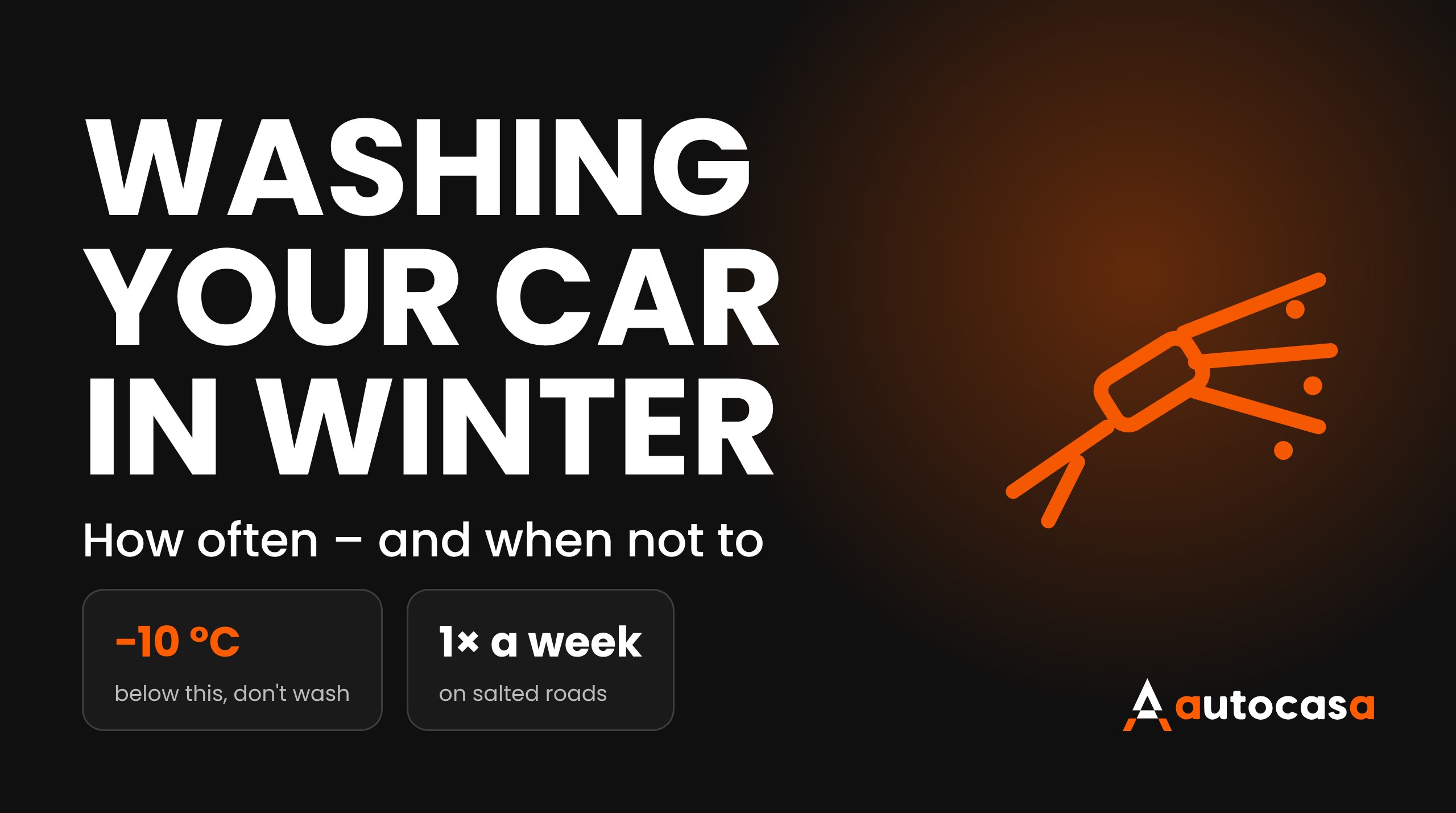
Winter road maintenance in Slovakia and Czechia is in full swing, and the familiar white film is settling on bonnets and wheel arches. Road salt is not a cosmetic problem: for the bodywork and the underbody it is the most aggressive substance a car meets all year. Washing a car in winter has its own rules, and one of them says that in hard frost you are better off not going to the car wash at all.
Why road salt is worse than the cold itself
On Slovak and Czech roads the main de-icing material is rock salt, that is sodium chloride. It is the cheapest option and available everywhere, but it has two drawbacks. In practice it only works down to about −10 °C; below that its de-icing effect all but disappears and road operators have to switch to calcium chloride, which works down to −35 °C, or magnesium chloride, with a limit around −30 °C. The second drawback: salt solution combined with water and air reliably starts corroding the steel that most bodies and chassis parts are made of.
A new car has factory corrosion protection, but its quality differs between models and model years and it weakens as the car ages. Older used cars suffer the most, because their paint or underbody coating already has scratches and cracks. The goal of winter care is therefore simple: keep the salt on the metal for as little time as possible.
How often to wash the car in winter
Recommendations depend on where you drive. If you use salted roads every day, specialists advise washing the car at least once a week. With low mileage and mostly city driving, where less salt is spread, an interval of around two weeks is enough. Regularity matters more than the exact number: motoring journalists like the comparison that a winter wash should be treated like brushing your teeth, not like a once-a-year spring clean.
One date is worth noting now: as soon as the frost eases at the end of winter and the roads are no longer salted, the car should be washed as soon and as thoroughly as possible, underbody included. Salt left in the seams until spring keeps working even when the summer tyres have long been fitted.
When it is too cold to wash
At temperatures below roughly −10 °C specialists advise against washing. Water gets into panel seams, locks, under trim strips and seals, freezes there, and the ice pushes apart whatever is in its way. On an older car with damaged paint that can end in more paint flaking off; at the door it can mean a frozen lock or a torn seal when you pull the handle hard in the morning.
Hot wax is also a bad idea in hard frost, because it does not spread evenly on cold paint. And watch the handbrake: after a wash, with the discs still damp, pads or shoes can freeze to the braking surface. In frost it is safer to secure the car with first gear engaged, with „P“ on an automatic, or by turning the wheels towards the kerb.
Which car wash is best in winter
- Self-service bay or touchless wash: the most sensible choice in winter. A high-pressure lance reaches where brushes cannot — wheel arches, suspension arms and dampers, where most of the salt sits. It pays to crouch down and go over the lower door edges and sills.
- Automatic brush wash: fast and fine for the bodywork, but it only cleans the underbody if you pay for the underbody programme. On its own it is not enough in winter.
- Underbody wash programme: in winter it is not a luxury but the main thing you are paying for. Salt sits underneath, not on the bonnet.
- Heated bay or hall: if there is one nearby, the surcharge is money well spent in frost. The car has a chance to dry before going back out into the cold.
What to do straight after the wash
- Dry it thoroughly. Not just the bodywork, but door frames, boot edges and the fuel flap. That is where water freezes most often.
- Treat the rubber seals. A silicone product or petroleum jelly stops doors freezing shut and extends the life of the rubber.
- Leave the handbrake off. After a wash in frost, secure the car with a gear or „P“ instead.
- Blow out locks and handles, and use graphite grease if needed. You will appreciate a working mechanical lock on the day central locking fails.
- Wipe sensors and cameras. Frozen water on parking sensors, radar or a camera will reliably knock the driver assistance systems out.
- Look the body over. Small cracks and the first rust blisters are easiest to spot right after a wash. The sooner they are repaired, the cheaper it is.
Winter care shows up in the selling price
Used-car buyers almost always look underneath these days. A clean, rust-free underbody and sound lower door edges are an argument that counts for more than the scent inside the cabin. It works both ways: if you are going to view a car in Slovakia or Czechia, take a torch and check the sills, wheel arches, damper mounts and tailgate edges. That is where you see whether the previous owner took the winters seriously.
And once the car is washed and dry, it is also the best moment for the photos in your listing. On AutoCasa.sk listing is free, with no sales commission and no limit on the number of listings; promoting a listing is optional and starts at 1.50 €. Besides cars there are categories for motorcycles, vans and trucks, buses, trailers, spare parts, wheels and tyres, and bicycles, so the winter set of wheels sitting in your garage can be sold in the same place.
The recommendations in this article are based on advice from workshops and the motoring trade press and on data about de-icing materials current as of November 2026, and they refer to conditions in Slovakia and Czechia. For specific paint and underbody care procedures, always check your vehicle’s service book.




 Slovenčina
 Čeština
 Angličtina
 Nemčina
 Poľština
 Slovinčina
 Ruština
 Taliančina
 Maďarčina
 Francúzština


Zatiaľ tu nie sú žiadne komentáre. Buďte prvý!