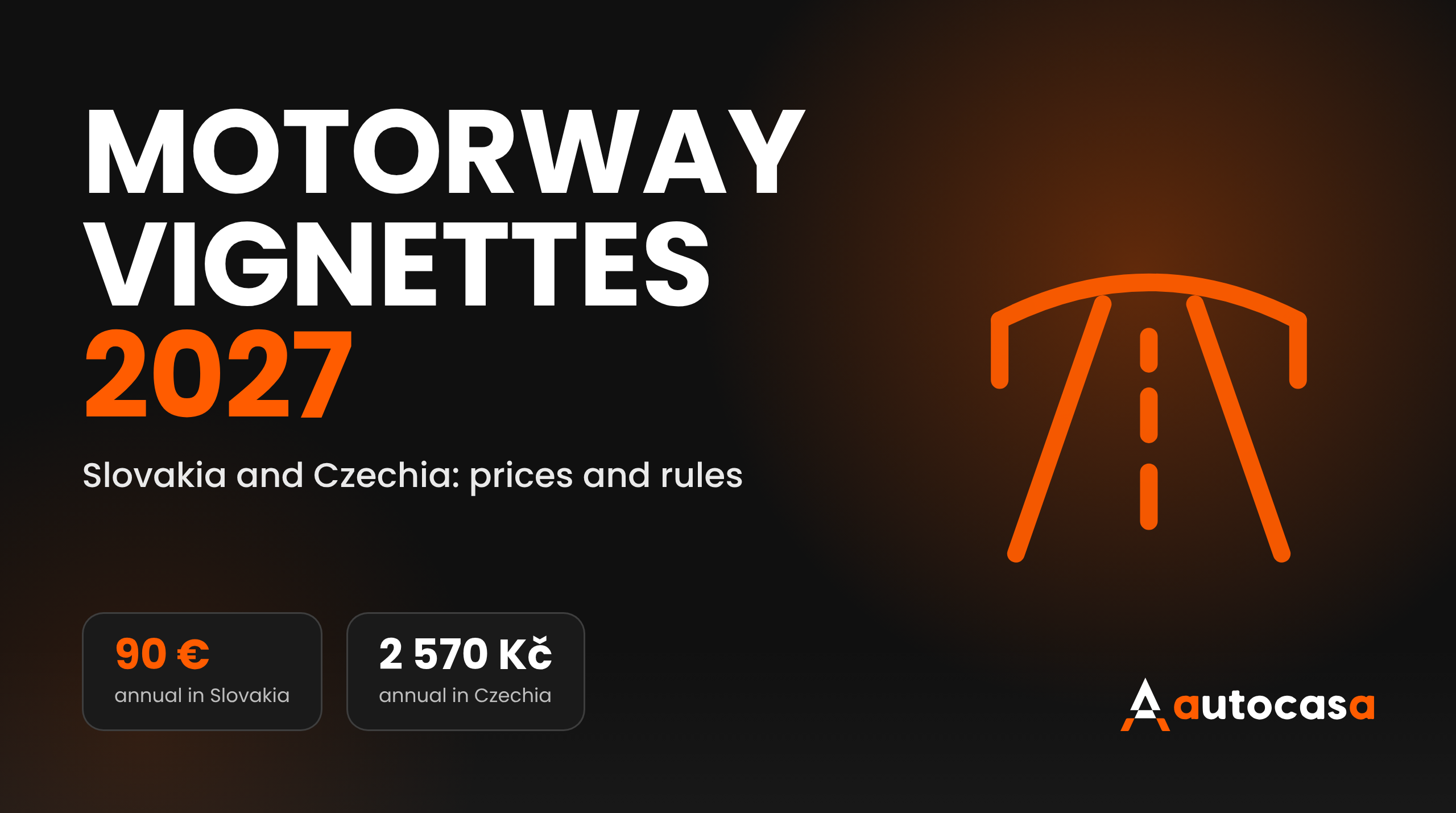
The end of the year is when thousands of drivers buy their motorway vignette for the next twelve months. Good news if you drive in Slovakia and Czechia: prices for 2027 are not set to rise on either side of the border. Less good news: half-truths about validity, trailers and what happens when a car is sold still cost drivers real money.
Slovakia: prices unchanged in 2027
Slovakia’s transport minister confirmed at the end of September that vignette prices will stay where they are next year. For vehicles up to 3.5 tonnes the rates remain:
- 365-day vignette: €90
- 30-day: €17.10
- 10-day: €10.80
- 1-day: €8.10
For context, the Slovak annual vignette last went up in 2025, from 60 to 90 euros. Freezing the price is not a discount, but for anyone crossing the country regularly it at least makes the cost predictable.
Czechia scraps automatic price rises
In Czechia the price has until now risen automatically with inflation every year. The Chamber of Deputies has approved an amendment removing that indexation, so the 2027 rates should stay at 2026 levels – annual CZK 2,570 (roughly €105), 30-day CZK 480, 10-day CZK 300 and one-day CZK 230. The bill still has to pass the Senate and be signed by the president.
One detail matters a lot for drivers in transit: the one-day vignette is set to be valid for 24 hours from purchase rather than until midnight on the day it was bought. Until now, joining the motorway at ten in the evening meant paying CZK 230 for two hours of driving.
Electric and hydrogen vehicles still use Czech motorways free of charge. Natural gas and biomethane vehicles pay half the rate and plug-in hybrids emitting up to 50 g CO2/km a quarter, which works out at CZK 1,280 and CZK 640 a year. Slovakia has no such exemption for electric cars.
The annual vignette does not run from January to December
This is the most common misunderstanding. Neither the Slovak nor the Czech annual vignette is tied to the calendar year. It is valid for 365 days from the date you choose when buying. Buying a fresh one on 1 January while the old one still runs into February simply means paying twice for the same days.
The Czech vignette can also be bought in advance and set to start up to 90 days later. If a January trip to Prague or the mountains is on the calendar, you can deal with it now instead of hunting for a sales point at the border.
Trailers, caravans and the category on the registration document
In Slovakia the vignette is mandatory for two-track motor vehicles and vehicle combinations up to 3.5 tonnes, and for category M1 vehicles regardless of weight. That produces a rule drivers towing a trailer regularly miss: if the whole combination exceeds 3.5 tonnes, you need a separate vignette for the trailer as well. For lighter combinations one is enough.
In Czechia the time-based charge applies to vehicles with at least four wheels and a maximum permissible weight up to 3.5 tonnes; heavier vehicles pay distance-based tolls instead. In both countries what counts is the figure in the registration document, not what the load actually weighs.
What driving without one costs
In Slovakia cameras check validity and liability sits with the registered keeper. In practice a payment order for €150 arrives in the post, reduced to €100 if paid within 15 days. In administrative proceedings the fine can reach several hundred euros, and it can be imposed up to two years after the journey – a foreign plate is no protection.
Czechia has no blanket automated checks; the offence is dealt with by the police and the customs administration. On the spot the fine can reach CZK 5,000, in administrative proceedings CZK 20,000, and up to CZK 100,000 where an exemption has been claimed fraudulently.
Buying a used car? The vignette follows the plate
A vignette is tied to the registration number, not to a person. If a car changes hands and keeps its plates, the vignette passes to the new owner, exactly like the old paper sticker on the windscreen. On an annual vignette with several months left that is worth tens of euros, so ask about it during the viewing and check the validity in the system.
If the registration number changes – when a car is exported, for instance – the vignette does not move by itself. The change has to be reported through a form on the official portal, with the documents of both vehicles. Transferring a vignette to an entirely different car is not possible.
Buy only from the official sites
Search results are often topped by paid links to sites that copy the official shop and add a „service“ or „environmental“ fee. The difference is usually tens of euros and in extreme cases more than double the real rate. The official channels are eznamka.sk for Slovakia and edalnice.gov.cz for Czechia, plus selected petrol stations, post offices and self-service kiosks.
Fewer running costs for a car you do not use
Vignette, insurance, servicing – paying for a car that only sits outside the house makes little sense. On AutoCasa you can offer it to other drivers free of charge: listings carry no sales commission and there is no limit on how many you post, while promoting a listing is optional and starts at €1.50. Alongside cars there are categories for motorcycles, vans and trucks, buses, trailers, spare parts, wheels and tyres, and bicycles.
If you are buying on the Slovak or Czech market instead, check the vehicle category and towing weights in the listing – and ask the seller how long the vignette is paid up for.
This article describes the rules in force in Slovakia (Act No. 488/2013 Z. z.) and Czechia (Act No. 13/1997 Sb.) as at 2 October 2026; the Czech amendment removing automatic indexation had at that point been approved by the Chamber of Deputies. These are not the rules of other countries. Check local requirements before travelling elsewhere.


 Slovenčina
 Čeština
 Angličtina
 Nemčina
 Poľština
 Slovinčina
 Ruština
 Taliančina
 Maďarčina
 Francúzština


Zatiaľ tu nie sú žiadne komentáre. Buďte prvý!