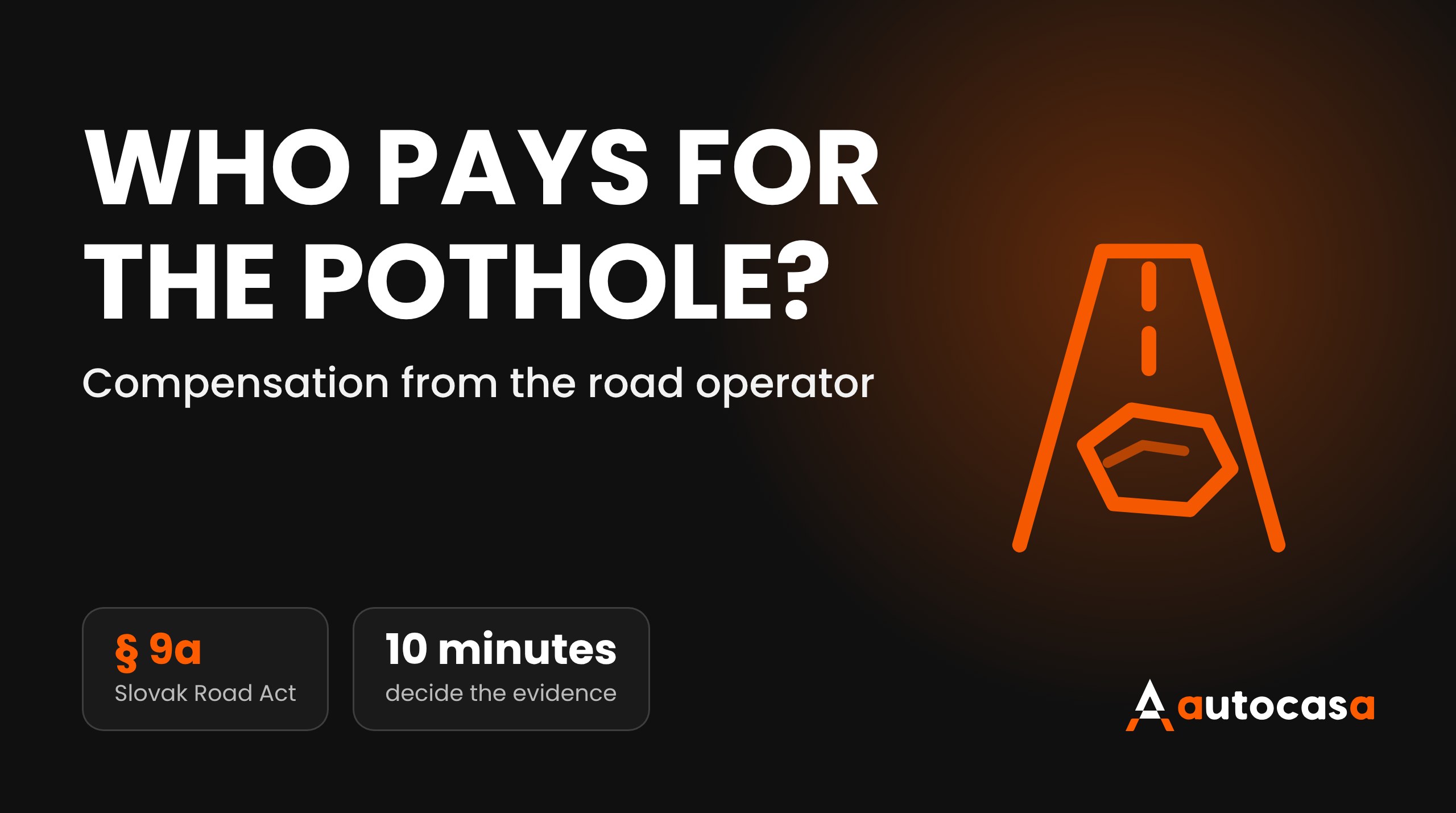
Winter road maintenance in Slovakia starts on 1 November, and with the first frosts comes the thing that costs drivers the most money: potholes. One deeper hole hidden under a puddle is enough to destroy a tyre, crack a wheel or throw the suspension geometry out. The law does recognise situations in which the road operator pays for that damage. It does not happen by itself, though — you have to file a claim and, above all, prove it.
Road condition versus a defect in trafficability
The key provision is Section 9a of Slovak Road Act No. 135/1961 Zb. Its first paragraph is blunt: users of motorways, roads and local roads have no right to compensation for damage arising from the construction or traffic-technical condition of the surface. So if a road is broken up along its whole length, you can see it and you can adjust your driving, the bill is yours.
The second paragraph is what every successful claim rests on: operators of motorways, roads and local roads are liable for damage caused by defects in trafficability, unless they prove that removing the defect or warning about it in the prescribed way was beyond their means. On that point the burden of proof sits with the operator, not with you.
The dividing line is predictability. An ordinary unevenness or a small hole on a visibly poor stretch is something a driver is expected to anticipate. A defect in trafficability, by contrast, is a sudden change you cannot foresee even when driving in a way adapted to the road surface and the weather — typically a deep hole in an otherwise continuous surface, covered by water or snow. In Czechia, where Act No. 13/1997 Sb. uses the same construction, a court accepted two holes 10 to 12 centimetres deep at 40 km/h as such a defect, but not the smaller holes around them. Depth alone does not decide it; the whole situation is assessed.
Who gets the bill
There is no single point of contact in Slovakia. The claim goes to the operator of the specific section:
- Motorways and expressways – Národná diaľničná spoločnosť, or the concessionaire on concession sections.
- Class I roads – Slovenská správa ciest.
- Class II and III roads – the self-governing region or its road authority.
- Local roads and car parks – the town or municipality.
Czechia splits it much the same way: motorways and Class I roads belong to the state and are managed by ŘSD, Class II and III roads to the regions, local roads to municipalities. If you are not sure who holds a given stretch, ask at the municipal office — they can usually identify the operator even for roads they do not maintain themselves.
The first ten minutes decide the outcome
Claims are usually rejected not because of the law but because the evidence is missing. The hole gets patched within days and you can no longer show what it looked like. So, on the spot and if traffic allows:
- Photograph the hole with the water that was covering it, then its depth — put a ruler, a coin or your keys next to it for scale.
- Photograph the wider scene including road signs and landmarks, so it is clear exactly where you were and that nothing warned of the defect.
- Record the exact spot — road number and kilometre, street name, nearest junction, or coordinates from your phone.
- Photograph the damage close up and the whole car: tyre, wheel, arch, suspension.
- Save the dashcam footage immediately, including the minutes before and after the impact. It is the strongest evidence you can have.
- Take witnesses‘ contact details with their consent.
- Call the police if the car is not driveable, there was a further collision, or you are unsure whether this counts as a road accident. A police record does not guarantee payment, but it helps a great deal in proving place and time.
How to file the claim
There is no nationwide form; each operator has its own procedure. On Class I roads the event is first reported to the insurer covering the operator’s liability, and once you have a claim number you send in the documents. Have ready your details and the vehicle’s details, the date, time and exact location, a description of what happened, the extent of the damage, the amount claimed, photographs, and whether the police were involved.
Prove the amount with a detailed invoice or repair estimate itemising parts and labour. It is worth asking the garage for a written record of what the technician actually found, and keeping the replaced parts. Do not wait: the evidence disappears with the first resurfacing, and claims become time-barred — simply filing with the operator does not stop the limitation period running. If you are refused, ask for written reasons.
What your own insurance covers
Slovak compulsory insurance, PZP, is the equivalent of third-party liability cover: it pays for damage you cause to others, not for your own car. Hitting a pothole is normally covered by havarijné poistenie, the local equivalent of comprehensive cover. Watch the deductible, and note that the insurer can reduce the payout if your driving was not adapted to the state of the road. A windscreen chipped by a stone goes through glass cover, which usually does not affect your no-claims discount.
For small damage — one tyre, say — the deductible often makes comprehensive cover pointless and claiming from the operator is faster. For larger damage the reverse makes sense: repair the car on your policy and pursue the operator in parallel.
One wheel is not a whole set
A pothole hit usually ruins one tyre and one wheel. You do not need to buy a full set — AutoCasa has a wheels and tyres category where single items and additions to an existing set are listed. Advertising is free, with no sales commission and no limit on the number of listings; promoting a listing is optional and starts at 1.50 €.
When buying a single wheel, check the tyre size and type, the bolt pattern and number of bolts, the centre bore and the ET offset, and for the tyre the DOT code and remaining tread depth. The replacement tyre should match the size and type of the one on the other side of the axle. And if the repair turns out to cost more than the car is worth, you can list it on AutoCasa under cars, motorcycles, vans and trucks, buses, trailers, spare parts, wheels and tyres, or bicycles.
This article is based on Slovak Act No. 135/1961 Zb. on roads and Czech Act No. 13/1997 Sb. as in force in October 2026, and applies to Slovakia and Czechia rather than to other countries. Check the procedure and contact details of the particular road operator before filing.



 Slovenčina
 Čeština
 Angličtina
 Nemčina
 Poľština
 Slovinčina
 Ruština
 Taliančina
 Maďarčina
 Francúzština


Zatiaľ tu nie sú žiadne komentáre. Buďte prvý!