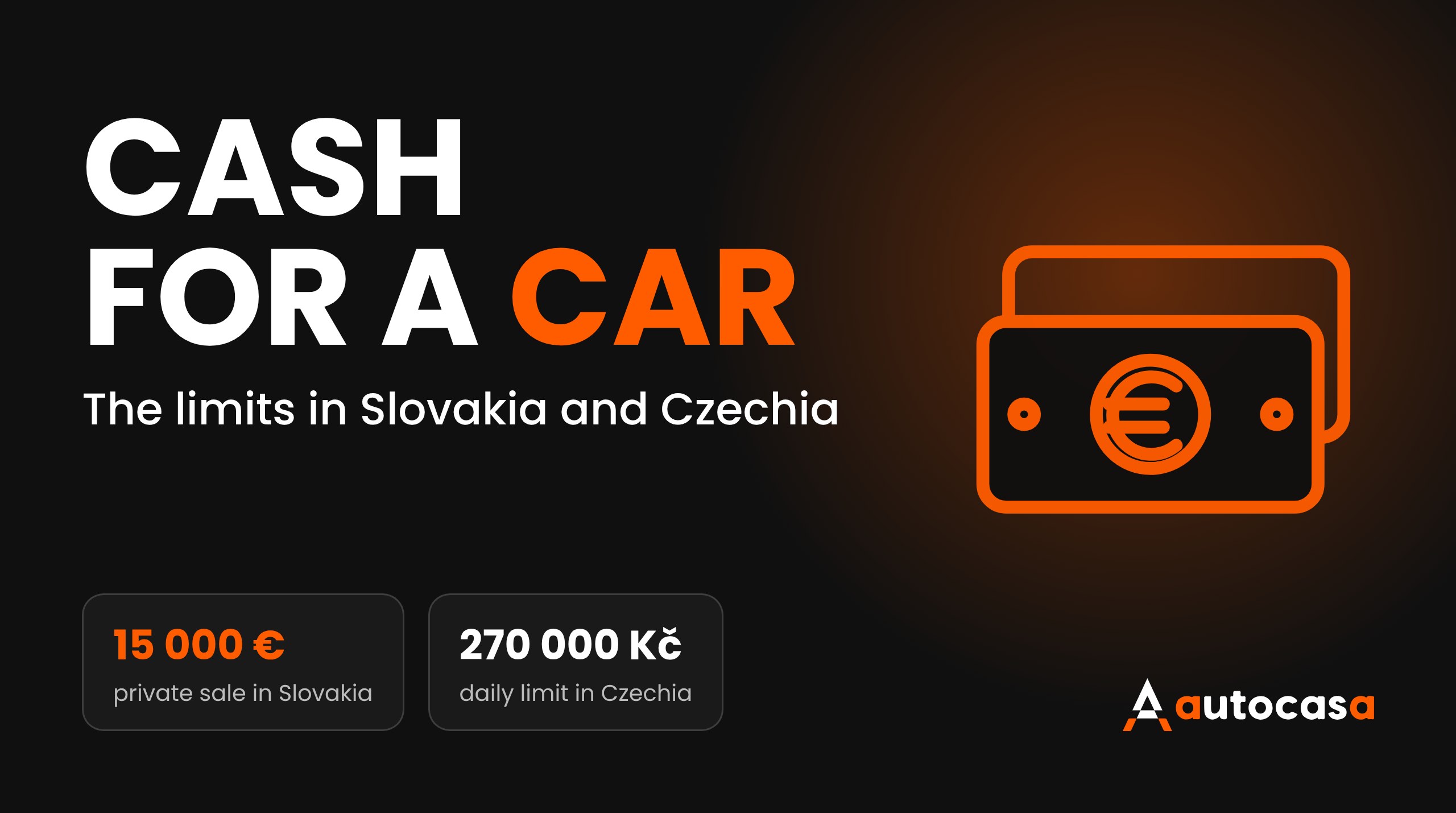
Buying or selling a used car in Slovakia or Czechia and planning to settle in cash? Both countries cap how much of the price may legally change hands in banknotes, the caps are lower than most people expect, and the penalty can land on the person who accepted the money just as easily as on the one who paid it. Here is what the law says and how to hand over the money safely.
Slovakia: two different ceilings
Slovak Act No. 394/2012 Coll. on the restriction of cash payments sets two thresholds, and which one applies depends on who is sitting on the other side of the table:
- 15,000 euros for a payment between two natural persons who are not acting as entrepreneurs – the classic private sale.
- 5,000 euros for everything else, meaning any payment where a business or a self-employed person is involved. Buying from a dealer, a car lot or a trader falls into this group.
The law bans a payment whose value exceeds the limit, so exactly 15,000 euros between two private individuals is still lawful and 15,050 euros is not. Splitting the price into two envelopes handed over on two days is not a workaround either – the limit applies to the value of the payment, not to the number of piles it arrives in.
Since 1 January 2026 the exemption that used to apply during a declared extraordinary situation has been removed, so the caps now hold in those periods too. The remaining exemptions cover crisis situations, war, martial law and states of emergency, plus a handful of specific cases such as court proceedings, enforcement and tax administration.
The recipient breaks the law as well
This is the part that surprises most people. The ban applies to the person handing the money over and to the person receiving it. Sell a car for 18,000 euros in cash to a private buyer in Slovakia and both of you have committed an offence.
The maximum fine is 10,000 euros for an individual and 150,000 euros for a company or a self-employed person. Fines imposed in practice tend to be far lower, but the risk is pointless when a bank transfer now clears in seconds.
Czechia: one limit, and a stricter one
Across the border, Czech Act No. 254/2004 Coll. sets a single ceiling of 270,000 Czech crowns – roughly 11,000 euros at current rates. It is tighter in two ways. It makes no distinction between private sellers and businesses, so there is no higher private-sale threshold. And it is a daily limit per recipient: everything the same payer hands to the same recipient during one calendar day is added together. Payments in a foreign currency are converted at the Czech National Bank rate for the day, so paying in euros does not sidestep it.
Fines reach 500,000 crowns for an individual and 5 million crowns for a business. Enforcement is real: according to available figures, the Czech tax administration issued 53 fines for breaching this limit in 2025, totalling more than 1.1 million crowns, and a used car paid for in cash is the textbook case.
Instant payments make cash unnecessary
The usual argument for cash – that a transfer only arrives the next day – no longer holds. Since 9 January 2025 every bank in the euro area has had to be able to receive instant euro payments, and since 9 October 2025 to send them, with the money credited to the recipient within 10 seconds, around the clock.
For a car sale that changes the whole choreography: the buyer sends the payment at the table, the seller checks the balance in their own banking app, and only then do the signatures and the keys follow. In Czechia domestic crown instant payments have been routine for years, while mandatory instant euro payments arrive for Czech banks in 2027, together with the check of the payee’s name against the account number.
Handing over the money without getting burnt
- Trust your own account, not the other party’s screen. A payment confirmation, a screenshot or an SMS proves nothing. Check the balance in your own app.
- For larger sums, meet at a bank branch. Cash can be paid straight into your account at the counter, where it is also counted and checked.
- Put the amount and the payment method in the contract. For a transfer, add the account number and reference; for cash, have the receipt signed.
- Never accept an overpayment. The buyer sends more than the price and asks for the difference back by another route – the original payment later turns out to be worthless.
- Keys, documents and service book go last, as does your signature on the re-registration, once the money is genuinely in your account.
- Meet somewhere public. A bank or shopping-centre car park with cameras beats an empty industrial estate.
An EU-wide cap of 10,000 euros from July 2027
Worth knowing if you are planning a more expensive purchase well ahead. EU Regulation 2024/1624 introduces a single 10,000 euro ceiling on cash payments for goods and services across the Union from 10 July 2027. It covers transactions where at least one party acts in a professional capacity, and linked payments are added together. Purely private deals between two individuals outside any business activity stay outside its scope, so national limits keep deciding there. Member states may also keep lower caps – France and Spain sit at 1,000 euros for business-related cash payments and Greece at 500 euros.
Once the price is agreed, the rest is paperwork
The smoothest sales are the ones prepared from the start: a clear price, a contract that names the payment method, a bank transfer, and the re-registration done as soon as the money lands. The harder part is reaching a buyer who is serious in the first place.
Listing on AutoCasa is free, with no sales commission and no cap on the number of ads; promoting a listing is optional and starts at 1.50 euros. You can list cars, motorcycles, vans, trucks, buses, trailers, spare parts, wheels and tyres, and bicycles.
State your payment terms in the advert itself. A line such as „bank transfer only, re-registration as soon as the payment clears“ will save you half the phone calls.
This article is based on Slovak Act No. 394/2012 Coll. as in force from 1 January 2026, Czech Act No. 254/2004 Coll. and EU Regulation 2024/1624, as at November 2026. The rules described apply to Slovakia and Czechia, not to other countries, and this is not legal advice – for large sums, consult your bank or a lawyer.


 Slovenčina
 Čeština
 Angličtina
 Nemčina
 Poľština
 Slovinčina
 Ruština
 Taliančina
 Maďarčina
 Francúzština


Zatiaľ tu nie sú žiadne komentáre. Buďte prvý!