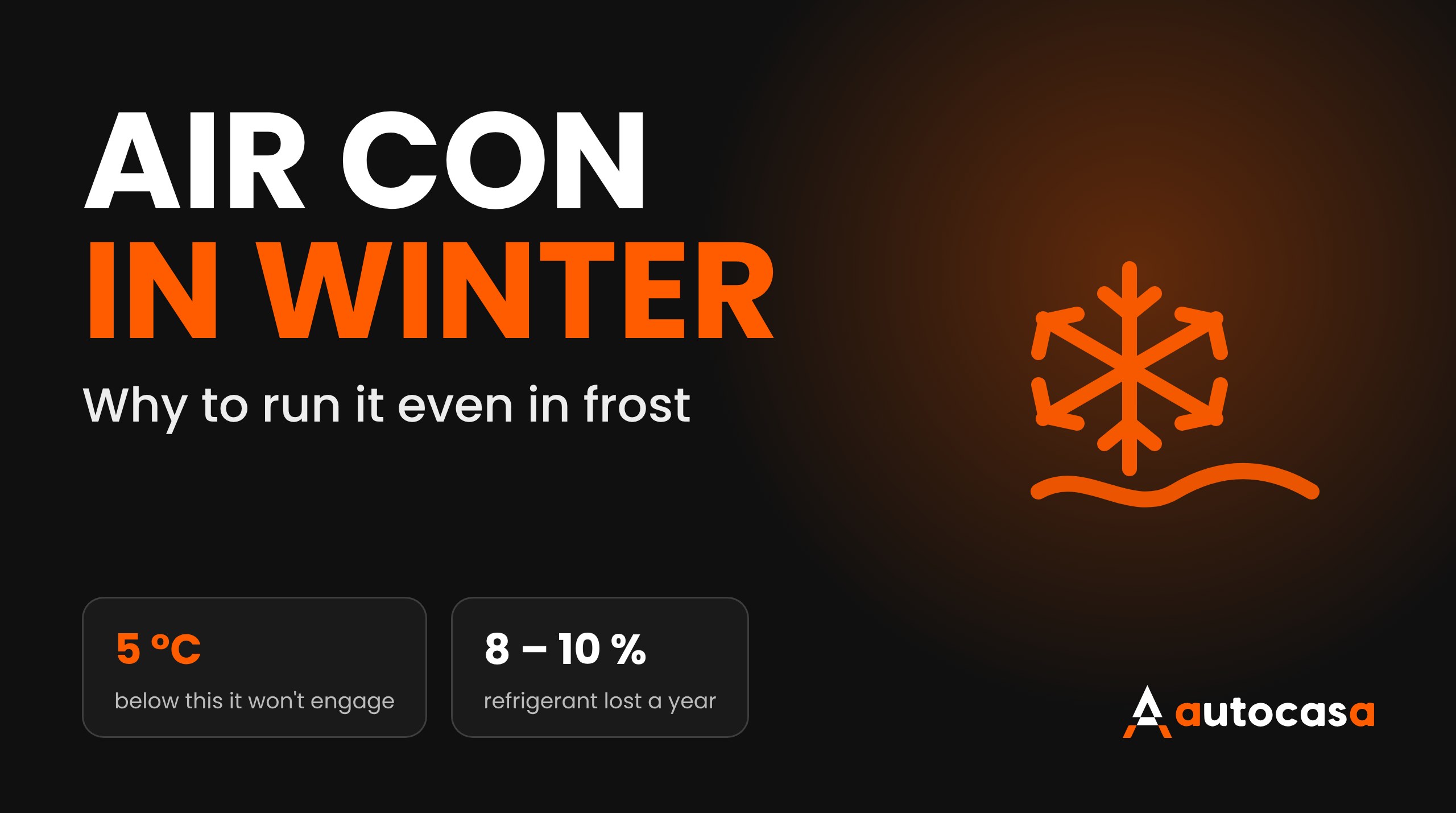
Headlines claiming Brussels is about to ban R134a refrigerant, and that an air-conditioning service on a ten-year-old car will cost a fortune, have gone around the region in recent weeks. The reality is calmer – but worth knowing for anyone driving a used car, or shopping for one, in Slovakia or Czechia. And right now, as mornings turn frosty, most drivers make one mistake that quietly kills the air conditioning.
What is actually changing around R134a
The European Union has not banned recharging the air conditioning in older cars. Regulation (EU) 2024/573 on fluorinated greenhouse gases sets no ban for mobile air conditioning – it caps the total amount of HFCs that producers and importers may place on the European market. That is a shared quota for the whole group of gases, not a ban on one refrigerant.
The figures are concrete. The quota starts from a 2015 baseline of roughly 176.7 million tonnes of CO2 equivalent. For 2025 and 2026 the cap sits at about 42.9 million tonnes; for the 2027 to 2029 period it falls to roughly 21.7 million tonnes. In other words, the permitted volume roughly halves from 2027. That is why refrigerant is expected to get more expensive – not because anyone outlawed it.
Topping up an older car with the same refrigerant remains legal. Directive 2006/40/EC explicitly preserves the option of recharging systems in vehicles placed on the market before 2017. Nobody will take your car off the road or order the air conditioning removed.
Even the quota fee is smaller than the headlines suggest: since 2025 it has been 3 euros per tonne of CO2 equivalent. For R134a, whose global warming potential is 1430, that works out at roughly 4.29 euros per kilogram – about 2.15 euros for a typical 500-gram charge. Service prices may well rise because refrigerant is scarcer, but this fee alone cannot cause a dramatic jump.
How to find out which refrigerant your car uses
Look under the bonnet: the sticker near the radiator or on the bulkhead usually lists the refrigerant type and charge weight. Two dates matter: since January 2011, refrigerants with a potential above 150 may not be used in newly type-approved vehicle types, and since 1 January 2017 new cars fitted with them may no longer be registered. The rule covers categories M1 (passenger cars) and N1 group I (light commercial vehicles up to 3.5 tonnes).
In practice: a car registered from 2017 almost certainly runs R1234yf, with a potential of around 0.5; an older used car normally has R134a. Buying a vehicle from the first half of the last decade, budget for air conditioning that gradually gets costlier to maintain.
Why to run the air conditioning even in frost
Here is the mistake most drivers make. The compressor has no oil sump of its own – the oil is dissolved in the refrigerant and circulates with it. Leave the system off all winter and the oil film disappears from pistons, bearings and valves; on the first spring start-up the compressor runs almost dry for several seconds. In the worst case it seizes.
The second reason is the seals. Regular running keeps them supple, so they crack less and the system leaks less. And leak it always does: according to the German motoring club ADAC, older systems lose 8 to 10 per cent of their refrigerant a year, which for a 500 to 1500-gram charge means 60 to 130 grams annually. New systems, by contrast, face a legal leakage limit of 40 grams per year (60 grams with two evaporators).
The third reason shows up first thing in the morning: air conditioning dries the air. Moisture condenses on the evaporator and drains outside, so the windows clear far faster than with the heater alone. Modern climate control engages the compressor by itself in demist mode; in older cars you press the A/C button yourself.
How to handle it in winter
- Switch on A/C during a normal drive every 10 to 14 days. Leave the heating at the usual 20 to 22 degrees; the air conditioning will simply dry the air.
- Don’t do five-minute runs with it. ADAC recommends avoiding run times under 10 minutes – a brief burst does more harm than good.
- Below roughly 5 °C outside the compressor will not engage. That protects the evaporator from icing up. The car then only heats and blows, even if the display suggests otherwise. If the frost lasts for weeks, drive into an underground car park or a heated workshop.
- Before parking, turn the cooling off and leave the blower running. The evaporator dries out and the system does not grow the bacteria and mould that cause spring odours.
- A service every two years. ADAC puts the cost at roughly 60 to 130 euros. Manufacturers usually only call for one once cooling noticeably drops – a routine inspection does not reliably measure performance.
- Cabin filter with activated carbon. Replace it after the damp autumn and winter, ideally in spring.
Buy a used car in winter and you cannot test the air conditioning
This is the hidden fault that catches out plenty of buyers in December and January. When it is freezing outside the compressor will not engage – so a dead air-conditioning system simply does not show up. The seller need not be hiding anything; they may not know about the fault either.
There is a way around it. Arrange the viewing in a heated hall or underground car park, let the car warm up, and watch whether the compressor engages after you press A/C – a soft click and a slight dip in revs. Ask for the receipt from the last service and check the unions and hoses: oily traces betray a leak. If the system cannot be tested, write that into the purchase contract, or knock the expected repair off the price.
It is not a trivial item. A basic air-conditioning service costs the equivalent of roughly 40 to 80 euros at Czech workshops. A seized compressor is another league: replacement runs to the equivalent of about 400 to 800 euros without labour, and twice that on premium brands. Repairing a seized compressor is rarely worth it; the whole unit gets replaced.
If you decide to sell after the winter
Working air conditioning is a selling point worth documenting. Attach the workshop receipt to the listing and put the refrigerant type and date of the last service in the description. A buyer looking at the car in winter will value that – and you avoid last-minute haggling.
On AutoCasa, listing is free, with no sales commission and no limit on the number of ads; promotion is optional and starts at 1.50 €. Besides cars you will find motorcycles, vans and trucks, buses, trailers, spare parts, wheels and tyres, and bicycles – so if an old set of parts is left over after the repair, it has somewhere to go.
This article draws on Directive 2006/40/EC, Regulation (EU) 2024/573 on fluorinated greenhouse gases and recommendations from the ADAC motoring club, as they stood in November 2026. The service prices quoted apply to Slovakia and Czechia, are indicative, and vary by model and region.


 Slovenčina
 Čeština
 Angličtina
 Nemčina
 Poľština
 Slovinčina
 Ruština
 Taliančina
 Maďarčina
 Francúzština


Zatiaľ tu nie sú žiadne komentáre. Buďte prvý!