The first frosty mornings are here, and owners of newer diesels are in for an unwelcome surprise: an AdBlue message appears on the dashboard, together with the number of kilometres the car will still start for. Dismiss it and keep driving, and a few days later you may be standing in a car park with an engine that refuses to wake up. Preventing that costs a few euros. Repairing the system once it fails costs hundreds, sometimes thousands.
What AdBlue is and why a diesel will not move without it
AdBlue is not a fuel additive and not an “engine cleaner”. It is an aqueous urea solution – 32.5 % technical urea and 67.5 % demineralised water – made to the international standard ISO 22241. It has its own tank with a light blue cap and is injected into the exhaust upstream of the SCR catalyst, where it breaks nitrogen oxides down into harmless nitrogen and water vapour.
That is exactly why AdBlue is as essential to the car as diesel itself. Without working nitrogen oxide reduction the vehicle would no longer meet the emission standard it was type-approved for, so manufacturers built a staged driver warning into the control unit: first a message, then a power limitation, and finally a refusal to start. This is not a fault but a deliberate safeguard – and it applies to most modern diesels badged BlueHDi, BlueTEC, SCR or Blue Motion.
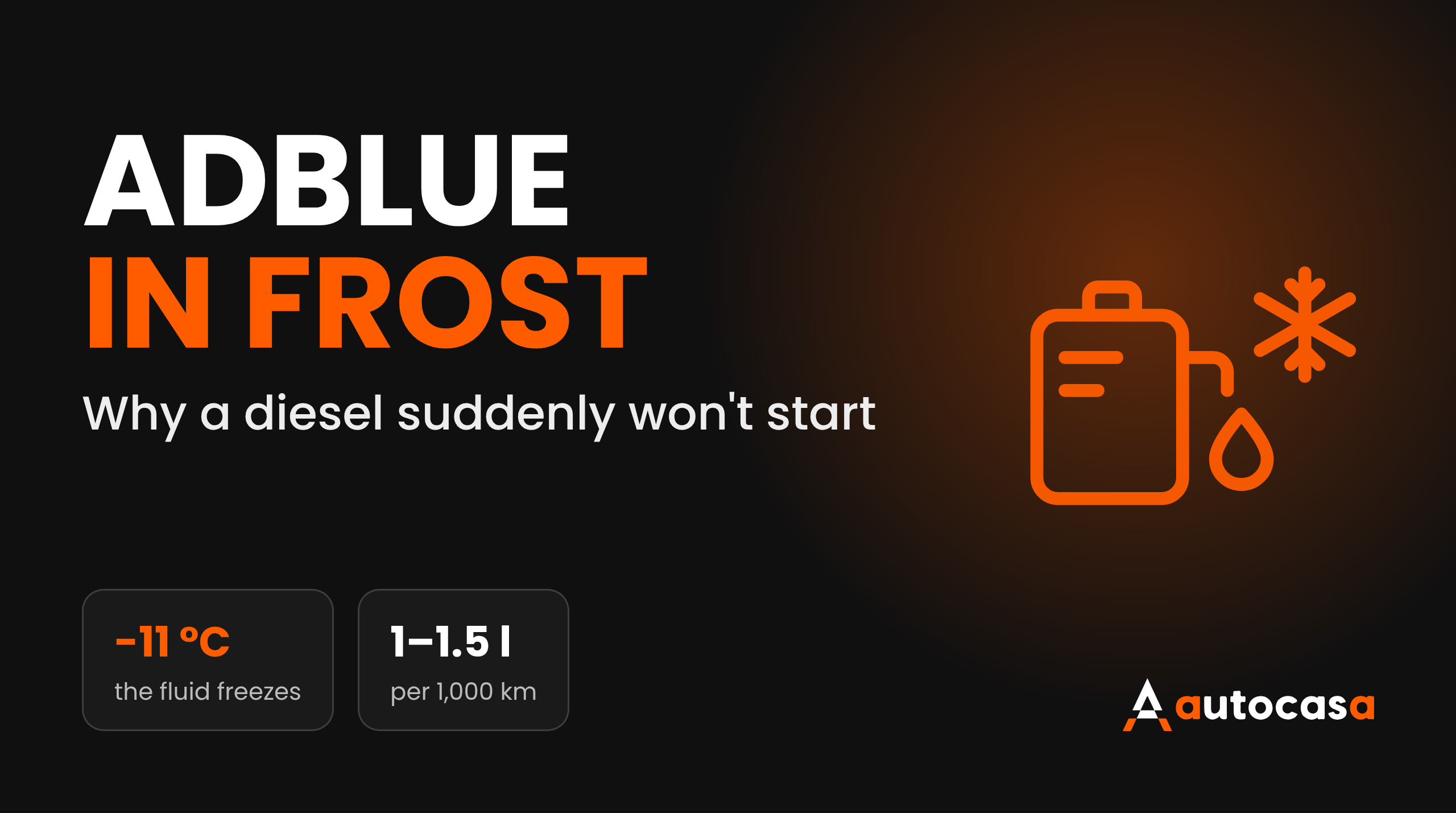
It freezes at minus 11 degrees. That alone is not a problem
AdBlue freezes at roughly -11 °C, so in a harder frost the solution in the tank genuinely does change state. There is nothing alarming about it: the tank and the feed lines are heated, the heating takes care of thawing once the engine is running, and the electronics monitor the temperature. Frozen AdBlue does not lose quality once it thaws, so a canister that spent the cold snap in your garage does not need to be thrown away – just let it melt somewhere warm.
The real problem lies elsewhere. Winter is the season when faults in heating elements and temperature sensors show up in full. In summer the car says nothing; at the first frost it suddenly cannot dose AdBlue – and the control unit reads that as an SCR system failure. The kilometre countdown to a start lockout then begins, even though the tank is full and the engine runs perfectly. That is why the first AdBlue messages pile up in November and December.
The second typically wintry mistake is topping up in the cold. If the canister sits all winter in the boot or in an unheated garage, you will pour out either slush or nothing at all. Top up AdBlue somewhere warm, ideally shortly after driving.
How much it uses and what it actually costs
AdBlue consumption in passenger cars runs at about 1 to 1.5 litres per 1,000 km, or roughly 3 to 5 % of diesel consumption. A car’s tank usually holds 10 to 25 litres, so a top-up is due every 10,000 to 15,000 kilometres – for many drivers once, at most twice, a year.
In Slovakia a litre costs roughly 0.70 to 1.10 €, which works out at some 10 to 20 € a year at normal mileage. In Czechia forecourt prices differ several times over: the cheapest stations start at around 0.30 € a litre, the priciest chains ask up to 1.00–1.20 €. Canisters from supermarkets remain the best value. A full top-up therefore means a few tens of euros – hardly a sum worth risking a locked-out starter for.
Crystals: the most expensive failure nobody talks about
When the water evaporates out of the solution, the urea leaves hard white crystals behind. They gradually clog the injection nozzle, the tank venting and the lines – the most common reason the system stops working. The risk grows on cars that cover short distances and stand for long periods, which is precisely the winter pattern of “to work in the morning, home in the evening”.
Worse still, several manufacturers combined the pump, the sensors and the electronics into a single plastic tank. Instead of replacing one sensor the workshop replaces the whole assembly, and the bill climbs past 1,000 €. Only prevention helps: certified AdBlue to ISO 22241, no unbranded solutions in PET bottles, and a canister sealed properly after opening.
One more thing: switching the SCR off in software, or fitting a so-called emulator, is an unauthorised modification of the vehicle. Afterwards the car no longer meets the emission standard it was approved for, and the problem does not go away – it simply moves to the “hidden defects” column at the next sale.
When the warning lights up: what to do, in order
- Read exactly what it says. “Refill AdBlue, start possible for another 2,400 km” is a call to top up. “Emission system fault” is a call to the workshop – topping up will not fix it.
- Do not dismiss the countdown. The warning typically appears 2,500 to 5,000 km before the tank runs dry; some cars start warning at 2,400 km, others only at 1,000 km. It is a final deadline, not a suggestion.
- Top up by whole canisters. Many cars only clear the message after a substantial refill, because they measure the level imprecisely. One litre “to see what happens” will not do it.
- No water, no diesel. Water dilutes the solution and the system detects it; diesel in the AdBlue tank means an expensive repair.
- Deal with an illuminated engine light before the roadworthiness test, not after. Do not count on a car with an active fault passing without complications.
What to check when buying a used diesel in Slovakia or Czechia
If you are looking at a used car with an SCR system – and there are more and more of them on the Slovak and Czech markets – AdBlue belongs to the things you can check on the spot, and the things most often forgotten during a viewing.
- Start the engine and read the instrument cluster carefully, including the AdBlue range menu. A seller who has the car “ready” with the engine already warm may be covering a message that only appears on a cold start.
- Ask for a diagnostic read-out. Reading the fault memory costs a few euros at a workshop and reveals stored SCR codes even when no light is on at that moment.
- Inspect the AdBlue filler cap. A broken, taped-over or crystal-encrusted cap tells you how the car was treated.
- Go through the service history. Replacing the AdBlue tank or pump is an expensive item that ought to be documented.
- Do the maths on your own driving. A diesel with SCR and a particulate filter makes sense on longer journeys. If you only cover ten kilometres of city traffic a day, a petrol car or a hybrid will get you through winter with less worry.
Selling or buying? Put it in the advert
When selling a diesel with SCR, it pays to be specific. The sentence “AdBlue topped up regularly, system fault-free, diagnostic read-out available” will save you and the buyer half the phone calls. A photo of the instrument cluster after a cold start helps too – the buyer sees at once that nothing is being hidden.
On AutoCasa you list your advert free of charge, with no sales commission and no limit on the number of adverts. Promoting a listing is optional and starts at 1.50 €. Besides cars you will find motorcycles, vans and trucks, buses, trailers, spare parts, wheels and tyres, and bicycles.
And if you are the one searching, browse the listings on AutoCasa.sk and AutoCasa.cz. For a diesel with SCR, bring two questions with you: when was the AdBlue last topped up, and has an emission system fault ever been reported? The answer will tell you more about the car than a polished engine bay.
The AdBlue prices and consumption figures in this article come from publicly available price lists and overviews as of November 2026, apply to Slovakia and Czechia, and are indicative – they vary by chain, packaging and car model. Exact top-up intervals and how the system behaves when AdBlue runs low are set out in your vehicle’s owner’s manual.


 Slovenčina
 Čeština
 Angličtina
 Nemčina
 Poľština
 Slovinčina
 Ruština
 Taliančina
 Maďarčina
 Francúzština


Zatiaľ tu nie sú žiadne komentáre. Buďte prvý!