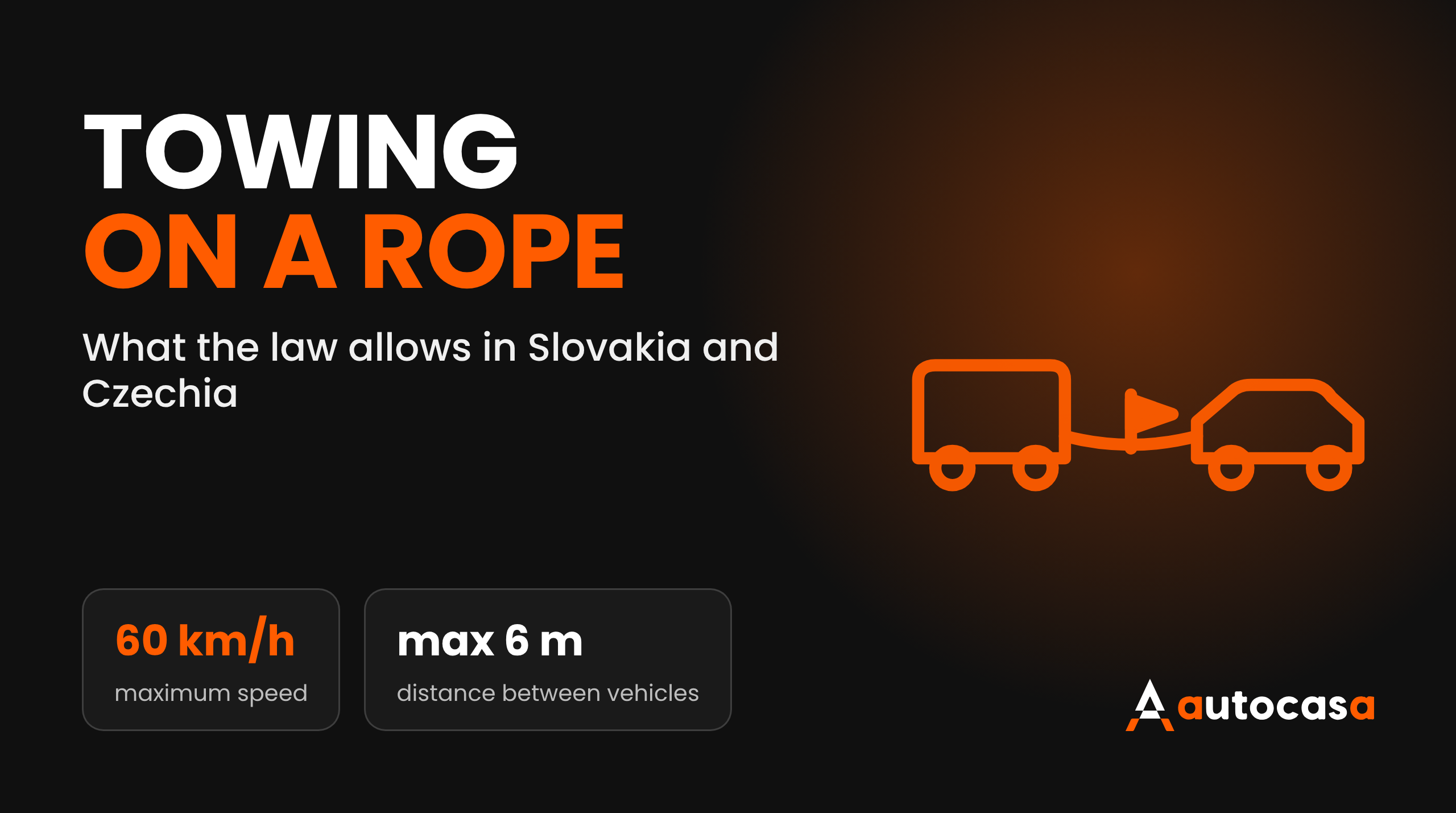
The first frosts are here, and with them the most common winter scene in any car park: a car that will not start. Before you call the friend with a tow rope in the boot, it is worth knowing that towing in Slovakia and Czechia follows precise rules – the speed limit, the length and marking of the link, and the roads where towing is not allowed at all. On some cars, a rope is the most expensive option you can choose.
Sixty kilometres per hour, and only with working brakes
The Slovak Road Traffic Act (Section 34 of Act No. 8/2009 Z. z.) is explicit: when a motor vehicle is being towed, the speed must not exceed 60 km/h. Only a vehicle with working steering and effective brakes may be towed. That is not a formality – a car on a rope brakes for itself, and without brakes it ends up in the bumper of the car pulling it.
If the brakes or steering do not work, the rope is out: a recovery vehicle must move the car with a special device – a dolly, a crane or a flatbed – and the towed car then needs portable lighting at the rear, connected to the towing vehicle. The duty most often forgotten: both drivers must agree in advance how they will communicate during the drive.
Rope, bar and how they must be marked
The length and marking of the link are set by Slovak Decree No. 9/2009 Z. z. The distance between the vehicles must not exceed 6 m; with a rope it must be at least 2.5 m, with a rigid bar at least 1 m. The bar is marked with alternating red and white transverse stripes 7.5 cm wide, the rope with a red flag or plate measuring at least 20 × 20 cm.
In Czechia, Section 34 of Act No. 361/2000 Sb. applies, and the differences matter: the flag on the rope must be at least 300 × 300 mm, the towed vehicle must carry a clearly visible warning triangle at the rear, and the towing vehicle must have its position lamps and dipped headlights switched on. Czech rules also allow a car without effective brakes to be towed on a rigid bar – but only if its instantaneous mass does not exceed the mass of the towing vehicle.
In both countries it is prohibited to tow more than one vehicle at a time or a vehicle with a trailer, though a motor vehicle with a semi-trailer may be towed. A motorcycle without a sidecar may neither be towed nor used to tow.
On the motorway, only to the nearest exit
On a Slovak motorway, towing is permitted only where it is necessary to remove the vehicle from the motorway, and only as far as the nearest car park or exit, where the car must leave the motorway (Section 36(3)). Carrying on for another fifty kilometres on a rope to get home is not an option.
The same logic applies to a fault that still allows you to drive: if the car cannot reach the required speed on level ground, you must leave the motorway at the next exit. In Czechia that threshold is set explicitly at 80 km/h on the level.
When a rope will not do, even with sound brakes
- Automatic gearbox: in most automatics, lubrication depends on the engine running. Manufacturers therefore advise against towing a modern automatic on a rope – the handbook usually gives a precise limit on speed and distance, or bans it outright.
- Electric car and plug-in hybrid: the manuals normally require transport on a flatbed only. Turning wheels drive the electric motor, and with the electronics shut down it has nowhere to send the energy it generates.
- Flat battery: without power the steering lock can stay engaged, and neither the power steering nor the brake assist works. Towing is then dangerous whatever the rules say.
- Faulty lights: in reduced visibility the towed car must show a white non-dazzling light at the front on the side facing the centre of the road and at least one red light at the rear, no more than 400 mm from the side profile.
- Missing towing eye: without it there is nowhere to attach the rope, and the recovery service charges extra for improvising. Check that it is actually in the boot.
What the assistance cover pays, and what you pay
Roadside assistance is part of most Slovak and Czech third-party motor policies, but the limits are low and differ sharply. Slovak packages typically cover towing up to 50 km, with a cap of a few dozen euros per insurance period (49.79 € in one widely sold package, a 150 € overall cap in another). Insurers also distinguish an accident from a breakdown: a breakdown is not an insured event, and assistance for it may be restricted, for example to vehicles no more than 10 years old.
Once the cap runs out, you pay the difference. A commercial tow within a Slovak town starts at roughly 60 €; outside town, expect around 1.20 € per kilometre, plus about 15 € for loading and 20 € per 30 minutes of waiting. Czech price lists are built differently: the call-out fee works out at roughly 40 – 90 € and covers the first 20 to 45 km, each further kilometre about 1.20 – 1.80 €, and a tow off the motorway costs 60 – 140 € more. Many price lists are quoted without VAT. Whatever the figure, call the assistance number on your insurance card first: the operator knows what is covered and sends a truck at an agreed price.
Check the boot – and sell what you no longer need
Before the first real frost it pays to open the boot and check three things: whether the towing eye is there, whether the rope or bar is marked as the rules require, and whether you know where the card with the assistance number is. Five minutes that save an hour on the hard shoulder.
If that leaves a tow bar, an old rope, a set of wheels or parts from a previous car sitting in the garage, offer them to other drivers in Slovakia and Czechia on AutoCasa. Listing is free, with no sales commission and no limit on adverts; promoting a listing is optional, from 1.50 €. You can list cars, motorcycles, vans and trucks, buses, trailers, spare parts, wheels and tyres, and bicycles.
The information in this article is based on Slovak Act No. 8/2009 Z. z. and Decree No. 9/2009 Z. z., and on Czech Act No. 361/2000 Sb., as in force in October 2026. The rules described apply in Slovakia and Czechia, not in other countries. The assistance limits and towing prices quoted are indicative – check them in your policy conditions and in the price list of the recovery service you use.


 Slovenčina
 Čeština
 Angličtina
 Nemčina
 Poľština
 Slovinčina
 Ruština
 Taliančina
 Maďarčina
 Francúzština


Zatiaľ tu nie sú žiadne komentáre. Buďte prvý!