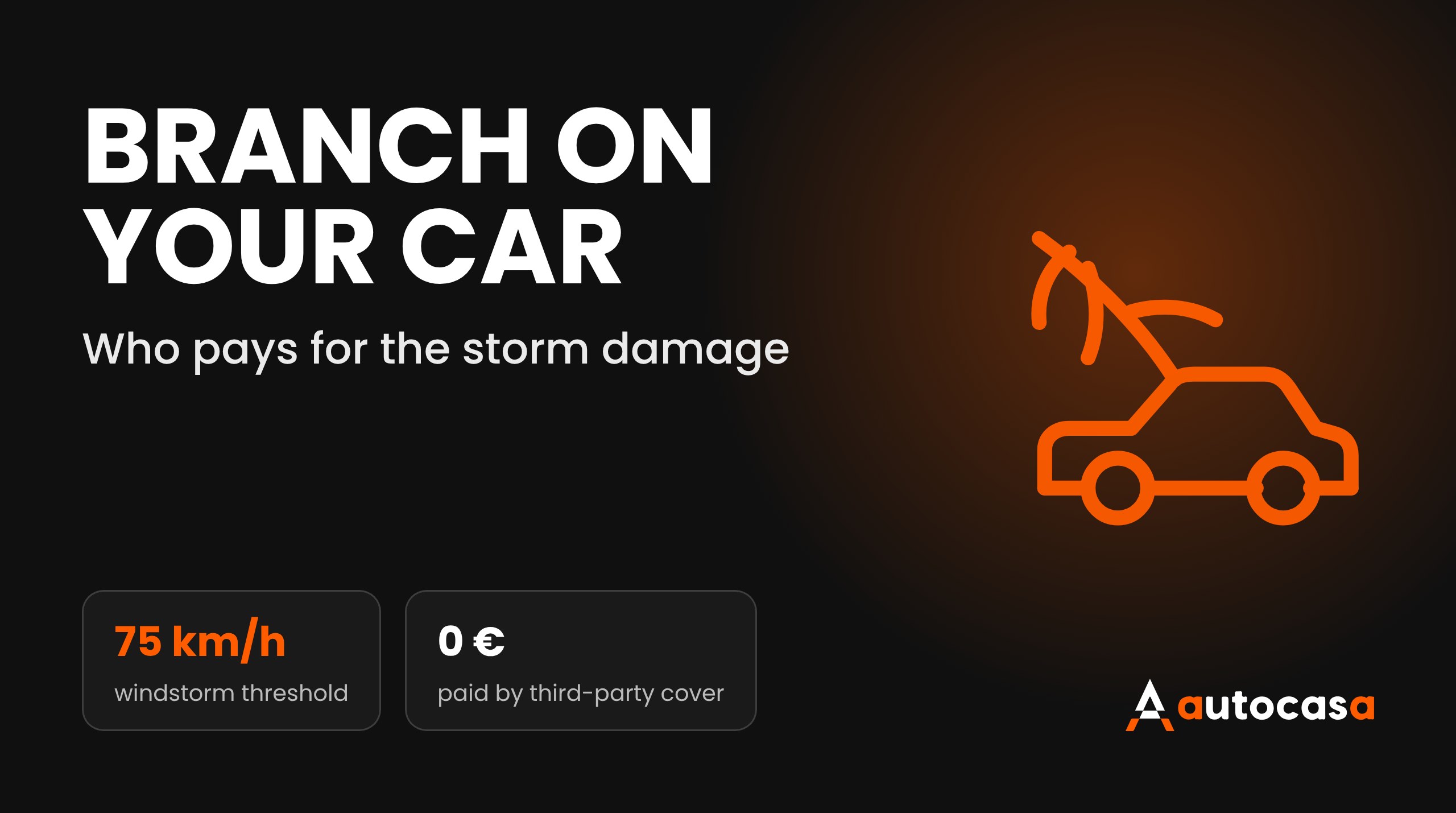
November is the month of wind in Slovakia and Czechia. One night of gales, or the first wet snow on branches that still carry their leaves, is enough: in the morning there is a branch across your bonnet, a cracked windscreen or a dented roof. Then comes the question that catches many drivers out: does the insurer pay, does the city pay, or does nobody pay?
Third-party cover will not pay for your own car
This is the most common misunderstanding. Slovak PZP and Czech povinné ručení – the compulsory motor third-party liability policies – cover damage you cause to someone else. Damage to your own car is not covered, even when you did nothing wrong.
For a falling branch, an uprooted tree, hail or sheet metal torn off a roof you need one of two things:
- Comprehensive cover (havarijné poistenie), which alongside collision and theft usually includes natural perils: windstorm, hail, falling trees and objects, lightning, fire, weight of snow and flooding.
- A natural-perils add-on to the compulsory policy. The cheaper route for older cars, where full comprehensive cover no longer pays off. Scope and payout limits differ sharply between insurers, so the wording is worth reading.
What counts as a „windstorm“: the 75 km/h threshold
This is where most claims fail. Most insurers define a windstorm as air movement reaching at least 75 km/h (about 20.8 m/s) at the insured location. Below that, there is formally no windstorm and the insurer may refuse to pay.
There are exceptions: some insurers on the Slovak market set the bar lower – Uniqa at 60 km/h and Groupama Garancia at 54 km/h, for example. Only the definition in your own policy wording matters, not the impression that „it was blowing hard“.
Insurers normally check wind speed against measurements from the Slovak SHMÚ, the Czech ČHMÚ or commercial weather services for that location. If no strong enough wind was recorded nearby, the burden of proof shifts to you: you must show that wind caused the damage and that the car was sound beforehand. In practice this is hard.
The first 30 minutes: what to do and what not to do
- Safety first. Do not climb under a leaning tree or loose roofing to „rescue“ the car. If another fall is likely or a branch blocks the road, call the fire brigade or the police.
- Photograph before you move the car. The whole vehicle from every side, close-ups of the damage, and the surroundings too: the branch on the bonnet, snapped limbs on the ground, hailstones, the flooded car park. Context matters as much as the dent.
- Do not wash the car and do not throw anything away. Keep broken glass and the snapped branch until the loss adjuster has seen them.
- Do not repair before inspection without the insurer’s consent. Repairing before inspection is the most common reason the extent of damage can no longer be proven and the payout is cut.
- Never start a flooded car. Have it towed; towing may be part of the claim if you have roadside assistance.
- Report the claim without delay – by phone, web form or the insurer’s app. Give the exact date, time, place, cause and extent.
Watch for one typical exclusion: parking under an obviously dead or leaning tree, or driving into an already flooded area, is treated as gross negligence. The insurer may then reduce or refuse the payout.
When the city or your neighbour pays
Owning the tree does not by itself create liability. Negligence does. Under the Slovak Civil Code (Act No. 40/1964 Zb., § 415 and § 420) the owner or manager of the land is liable where care of the tree was neglected – the tree was dead, leaning, visibly damaged at the trunk, or an arborist had flagged it. The duty to keep land and vegetation in a safe condition also follows from § 127 of the same code. The same principle applies in Czechia under Civil Code No. 89/2012 Sb.
Conversely, a healthy tree uprooted by an exceptional storm is generally treated as force majeure and nobody is liable. That is exactly the case where only your own comprehensive or natural-perils cover helps.
If you want to claim compensation, the burden of proof is on you. So photograph the stump and the break point right there – dry, rotten or hollow wood is the strongest argument. Find out who owns or manages the land (land registry, the municipality, the road authority), send a written demand with photos and a repair estimate, and note down witnesses. In Czechia the limitation period is three years from the moment you learned of the damage and of the liable party.
Buying used: how to spot a storm-damaged car
Hail-damaged cars and cars hit by branches return to the market regularly: repair is cheaper than a write-off, and the seller is not obliged to raise it. What to look at:
- Roof, bonnet and wing edges in raking light. Stand to the side and look along the painted surface against the light. Hail leaves shallow, evenly spaced dimples that are invisible head-on.
- Paint thickness. A cheap gauge shows whether the roof or bonnet has been resprayed. In ordinary collisions the roof stays untouched – a resprayed roof is a warning sign.
- Uneven panel gaps between bonnet, wings and doors, filler residue in the roof drainage channels, and scratched trims around the windscreen after a replacement.
- A musty smell and a damp boot – traces of flooding, the worst variant of all. Check under the carpet and under the spare wheel.
When the repair costs more than the car
On older cars a new roof, glass and paintwork exceed the vehicle’s residual value. The insurer then declares a total loss: it sets the car’s value before the event, deducts the salvage value and the excess, and pays the difference. If the car has no comprehensive cover, the decision is yours.
A driveable car with an ugly roof will find a buyer who looks at the price rather than the looks. A non-runner has its value in parts – lights, electronics, doors, interior and wheels sell very well.
On AutoCasa you can list either one at no cost. Advertising is free, with no sales commission and no limit on the number of listings; promoting a listing is optional and starts at 1.50 €. Beyond cars, the categories include motorcycles, vans and trucks, buses, trailers, spare parts, wheels and tyres, and bicycles – so a set of wheels from a written-off car can be sold on its own.
With a damaged car, be open in the listing: write what happened, whether it has been repaired, and add photos of the affected areas. A buyer looking for a project or for parts will not be put off – they will get in touch sooner than someone who would feel misled on arrival.
This article describes the rules that apply in Slovakia and Czechia, not in your own country. The liability information is based on Slovak Act No. 40/1964 Zb., the Civil Code (§ 127, § 415 and § 420), and Czech Act No. 89/2012 Sb., as in force in November 2026. Wind-speed thresholds, excesses and exclusions differ between insurers – your own policy wording always prevails.


 Slovenčina
 Čeština
 Angličtina
 Nemčina
 Poľština
 Slovinčina
 Ruština
 Taliančina
 Maďarčina
 Francúzština


Zatiaľ tu nie sú žiadne komentáre. Buďte prvý!