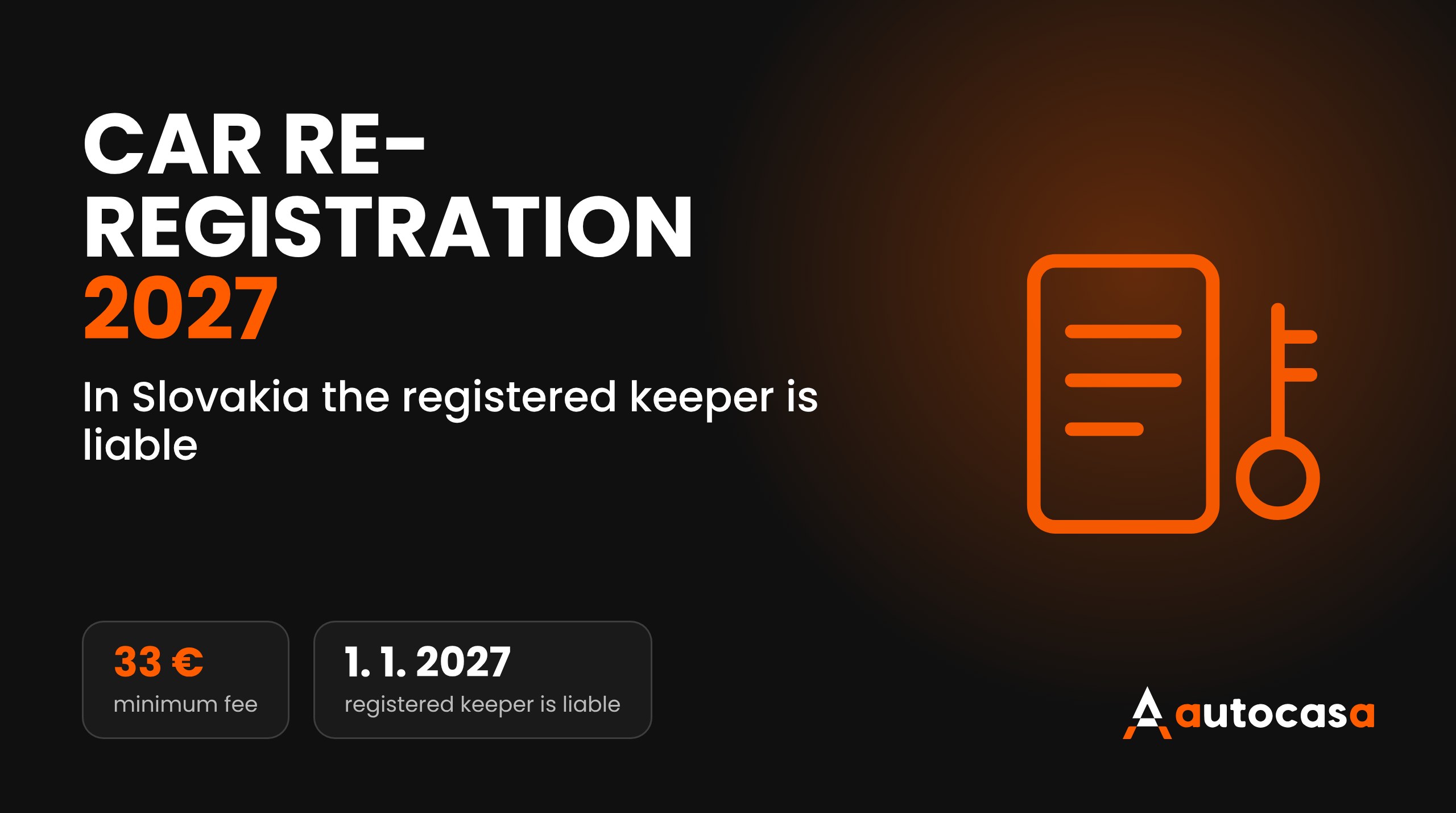
Contract signed, hands shaken, the car drives off the yard. The re-registration will be „sorted out sometime this week“. From 1 January 2027 that entirely ordinary situation turns into a risk the seller pays for. An amendment to Slovakia’s vehicle operation act is blunt about it: the duties of the registered keeper fall on whoever is entered in the register, no matter what the contract says.
What changes in Slovakia on 1 January 2027
The change sits in Section 45(3) of Act No. 106/2018 Z. z. on the operation of vehicles. Under the new wording, the person entered in the state vehicle register is responsible for the keeper’s duties. Not the person actually driving the car, and not the person who bought it a month ago.
In practice that means two things. First, the validity of the Slovak roadworthiness test and emissions test is the registered keeper’s problem. If the buyer lets them lapse, the consequences come back to the name on the papers. Second, penalties imposed on the keeper – speed captured by a camera, an unpaid motorway vignette, bad parking – land at the address in the register. A sales contract in a drawer will not automatically stop any of it.
That matters especially to buyers from abroad who collect a car in Slovakia and plan to register it at home. For as long as the vehicle sits in the Slovak register under the previous keeper’s name, the previous keeper carries the risk.
The law allows 30 days. Give yourself one
Slovak Act No. 8/2009 Z. z. on road traffic requires a change of ownership to be reported within 30 days. That deadline is a ceiling, not a plan. The whole transfer is now handled in a single step at any traffic inspectorate in Slovakia – there is no longer a separate de-registration in one town and registration in another.
The sensible approach is to complete the transfer together with the buyer on the day of sale, at the latest the next working day. If that is impossible, take a power of attorney with an officially certified signature and check the entry a few days later. If the buyer stops replying, report the change at the inspectorate yourself.
What the transfer costs in Slovakia
The administrative fee for registering a keeper is a rate based on engine power multiplied by an ecological coefficient tied to the vehicle’s emission standard. The floor is 33 € and the fee never drops below it.
- Rate by power: 33 € up to 80 kW, 60 € above 80 and up to 90 kW, 90 € up to 100 kW, 120 € up to 110 kW, 200 € up to 125 kW, 300 € up to 140 kW, rising further to 1,000 € above 210 kW.
- Ecological coefficient: 0.60 for Euro 4, 0.50 for Euro 5, 0.45 for Euro 6a to 6c and 0.40 for Euro 6d and newer. Hydrogen and plug-in hybrid vehicles get 0.20, vehicles first registered more than 40 years ago get 0.10.
- Example: a used petrol car with 120 kW and Euro 4 works out at 200 × 0.60 = 120 €.
- Electric cars pay a flat 33 € regardless of power.
- Filing electronically through the Slovak portal with an eID cuts the fee by 50 %, but by no more than 50 €. In the example above you pay 70 € instead of 120 €.
- New number plates cost 25 € each, so 50 € a pair, and half that when filing electronically. If the buyer keeps the existing plates, there is nothing to pay.
A 50 % reduction also applies to holders of the Slovak ŤZP or ŤZP-S disability card who received no state contribution towards the purchase, and to families claiming child benefit for at least four children, for an M1 vehicle with at least six seats and up to 110 kW. Inheritance is among the exempt cases.
Deadlines are tighter in Czechia
Across the border the system works differently. The application to record a change of owner must be filed within 10 working days of the transfer of title, and missing the deadline can cost up to CZK 50,000. The administrative fee for a passenger car is CZK 800, or CZK 640 when the application goes through the Portál dopravy.
Older vehicles attract an additional ecological fee paid by the new owner: CZK 3,000 for Euro 2, CZK 5,000 for Euro 1 and CZK 10,000 for a vehicle that does not even meet Euro 1. From Euro 3 upwards there is nothing to pay. Czech keeper liability sits in Section 125f of Act No. 361/2000 Sb., and filing the application to record the change is precisely what releases you from it. Under Section 8a of Act No. 56/2001 Sb., one party can file the application alone, without the other.
What to bring
- Identity documents for both parties, or a power of attorney with an officially certified signature.
- The Slovak registration certificate part II and the chip card part I, if one was issued.
- Proof of compulsory third-party insurance in the new keeper’s name – the previous policy ends with the change of keeper.
- A valid roadworthiness test and emissions test.
- The sales contract in two copies, with the date and time of handover.
Sell without waiting on the buyer
The people who run into the fewest problems are those who give themselves time to find the right buyer and agree the appointment at the office before handing over the keys. On AutoCasa listings are free, with no sales commission and no limit on how many you post, so a car can stay on offer as long as it needs to. Promoting a listing is optional and starts at 1.50 €.
Put the power in kW and the emission standard from the registration papers into the listing. Buyers can work out the transfer cost immediately, and you save yourself dozens of messages asking the same question. Besides cars, the platform also covers motorcycles, vans and trucks, buses, trailers, spare parts, wheels and tyres, and bicycles.
The information in this article applies to Slovakia and Czechia. It is based on Slovak Act No. 106/2018 Z. z. in the wording effective from 1 January 2027, Act No. 8/2009 Z. z., the schedule of administrative fees under Act No. 145/1995 Z. z., and Czech Acts No. 361/2000 Sb. and No. 56/2001 Sb., as known on 31 October 2026. Confirm the exact fee with the authority before your visit.


 Slovenčina
 Čeština
 Angličtina
 Nemčina
 Poľština
 Slovinčina
 Ruština
 Taliančina
 Maďarčina
 Francúzština


Zatiaľ tu nie sú žiadne komentáre. Buďte prvý!