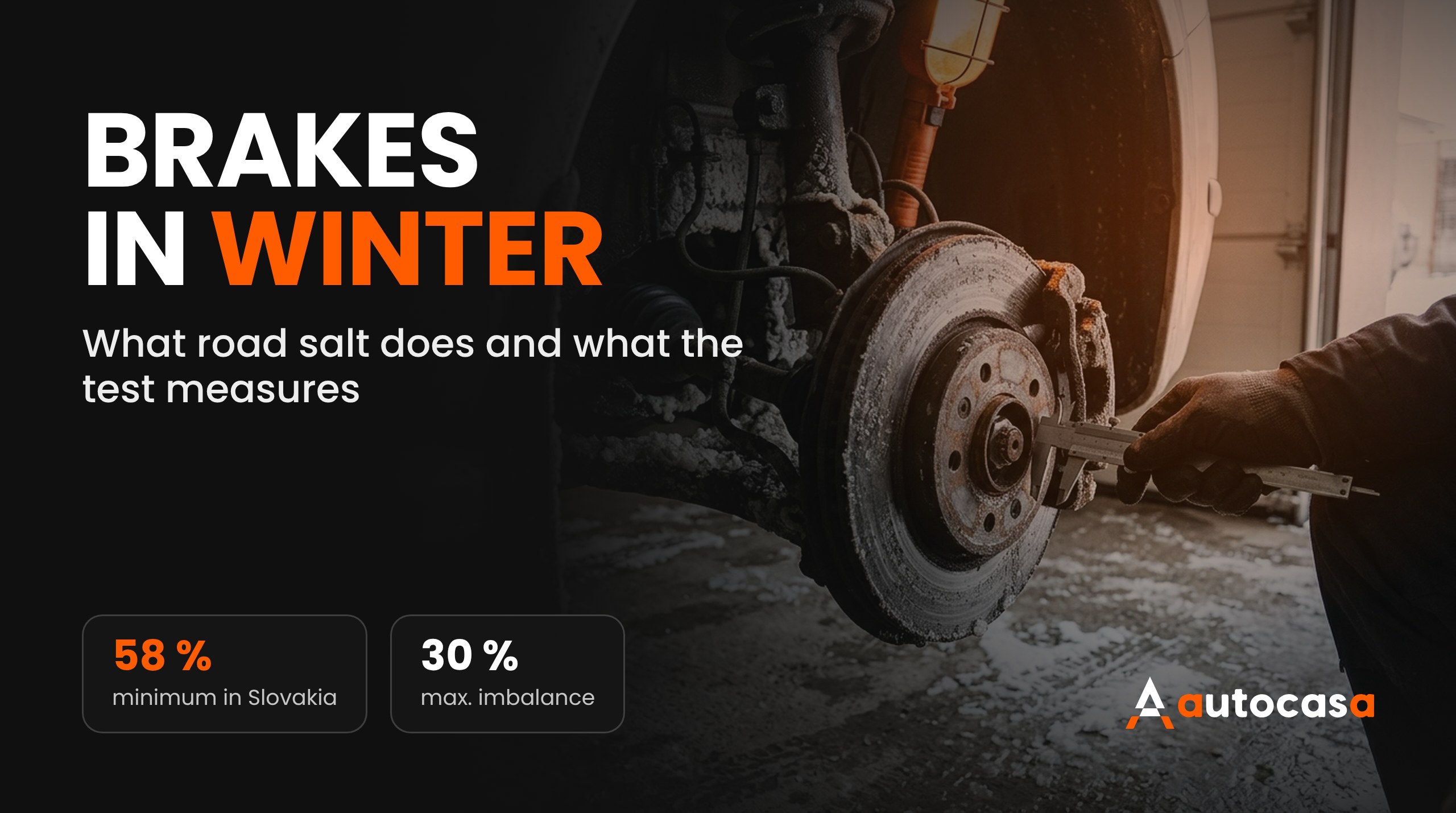
Road salt, damp and frosty mornings: in winter nothing on a car works under worse conditions than the brakes. Most drivers only notice them when they squeal on the first stop of the day, or when a Slovak test station writes a major defect into the inspection report. Here is what winter actually does to brakes, the figures a car has to reach in Slovakia and Czechia, and what to check on a used car before you hand over the money.
Why brakes squeal after a frosty night
The usual culprit is surface corrosion on the brake discs. In damp, salt-laden air it can form after only a few days of standing. The first few metres of driving wipe it off and the squeal stops: cosmetic, not a fault.
A car that has stood for weeks is a different story. The rust sits deeper, the disc can stay uneven, and you feel it as a pulse through the pedal. Simple rule: a noise that disappears within the first kilometre can be ignored. A noise or vibration still there after ten kilometres belongs in a workshop.
Salt does not stop at the disc
Road salt and grit work their way into the caliper guide pins. After you release the pedal the caliper no longer retracts fully and the pads stay resting on the disc. The car drags, fuel consumption climbs, the brake overheats and the friction material wears unevenly — noticeably faster on one side of the axle than the other.
The handbrake mechanism suffers the same way: clogged cables and levers lose their smooth travel, and on older cars replacement is often the only fix. Prevention is cheap by comparison — cleaning and greasing the guide pins at every tyre change costs a fraction of a new caliper.
What the Slovak test station actually measures
A Slovak inspection station (STK) does not judge brakes by feel but in per cent braking efficiency. For a passenger car (category M1) the service brake minimum is 58 % for vehicles first registered from 1 January 2012, 50 % for older ones and 48 % for cars without ABS or registered before 1 October 1991. The parking brake has to reach at least 16 % of the maximum permitted mass.
The second figure, far more often overlooked, is brake imbalance. The braking force at one wheel may not fall below 70 % of the highest force measured at the opposite wheel on the same axle — so the difference may not exceed 30 %. And that is exactly the difference a caliper seized with salt and grit produces.
In Czechia the limits for a passenger car are 50 % for the service brake and 16 % for the parking brake, with the same maximum 30 % imbalance. Note that these are Slovak and Czech rules, not the ones you may know from home: if you buy or sell in Slovakia or Czechia, these are the numbers your car is measured against.
Major defect: 60 days in Slovakia, 30 in Czechia
Uneven braking is recorded as a major defect (category B). In Slovakia the car is then rated „dočasne spôsobilé“, temporarily roadworthy, and you have 60 calendar days for the repair and the re-test. Turn up on day 61 and the whole inspection starts again.
In Czechia the window is shorter: with a major defect the vehicle stays roadworthy for only 30 days from the date on the report. A dangerous defect (category C) means, in both countries, an unroadworthy vehicle, a driving ban and a tow at your own expense.
Six things you can check yourself
- Disc thickness: the disc itself or the part documentation carries a MIN TH figure — the minimum thickness set by the manufacturer. Measure on the friction band where the pad runs, not at the outer edge, where a lip remains and the reading comes out falsely high.
- Pad material: below roughly 2 to 3 mm of friction material it is time to replace them.
- Brake fluid: it draws moisture from the air and then forms vapour bubbles well before the boiling point printed on the label. The pedal goes soft. Change it at the interval the car manufacturer specifies.
- Pulling and pulsing: if the car veers under braking or the pedal pulses, that typically means uneven braking or a warped disc.
- Brake lines: flaking paint, blisters and scaly rust around the lines are a reason for an immediate workshop inspection.
- Handbrake: on a dry, slightly sloping stretch, check whether the car holds. If the lever has to come almost all the way up, the mechanism is clogged.
On a used car in winter, a clean disc is not enough
At a winter viewing the disc and caliper are often packed with snow and salt, and under the layer of grime you can see almost nothing. Ask for the report from the last technical inspection instead: it carries the measured percentages and any note about imbalance. On the test drive, brake from a decent speed on an empty, dry stretch and watch whether the car holds its line.
A valid inspection is no proof that the brakes are healthy — it describes the condition on one particular day. And a disc above the minimum thickness can still be due for replacement if it has cracks, deep scoring or heavy corrosion.
Brake parts do not have to be new
Calipers, discs and complete sets are available second hand too, especially for older cars where a new original part costs more than the residual value of the vehicle. On AutoCasa that is the spare parts category, alongside wheels and tyres. Listing is free, with no sales commission and no limit on the number of ads; promoting a listing is optional and starts at 1.50 €.
If you are selling brake parts, put the vehicle model and engine, the part number, the mileage and — for discs — the measured thickness in the ad. Add a photo of the friction band and the outer edge. The buyer sees straight away what they are getting, and you stop answering the same questions over and over.
The figures for the Slovak technical inspection come from methodological instruction no. 48/2018 (version in force from 1 September 2021), and for Czechia from decree no. 211/2018 Sb. and act no. 56/2001 Sb., as of November 2026. These rules apply in Slovakia and Czechia. Always check the specific limits for your own vehicle in the manufacturer’s documentation and with the test station.



 Slovenčina
 Čeština
 Angličtina
 Nemčina
 Poľština
 Slovinčina
 Ruština
 Taliančina
 Maďarčina
 Francúzština


Zatiaľ tu nie sú žiadne komentáre. Buďte prvý!