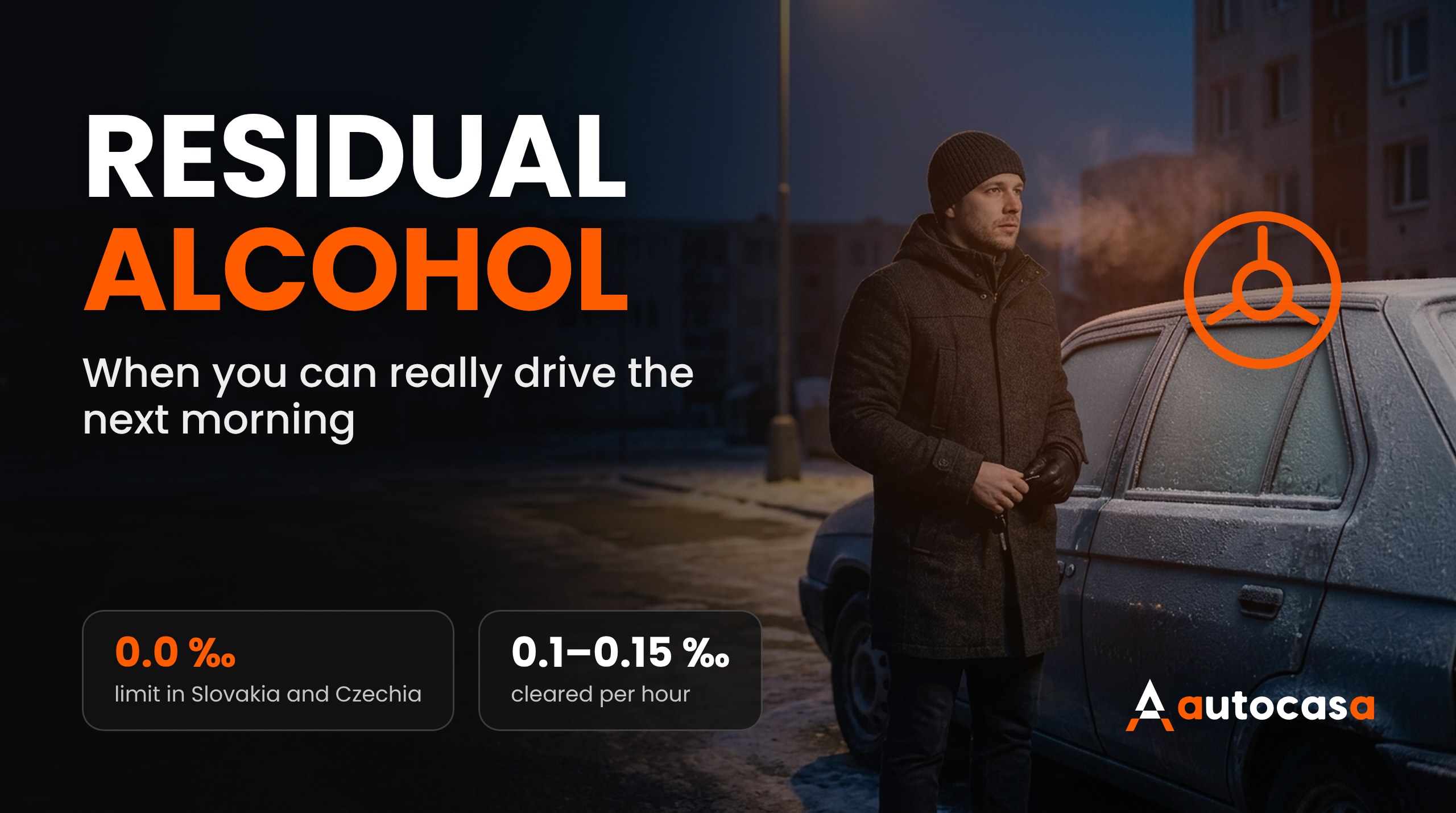
The season of office parties and pre-Christmas get-togethers has just started, and with it comes the question thousands of drivers ask every December: how many hours after the last drink is it safe to get behind the wheel? In Slovakia and Czechia the limit is zero, so the answer is not „a little is fine“ but „none at all“. And the morning after is where most drivers slip up: they feel completely normal, but the breathalyser says otherwise.
Zero tolerance really does mean zero
The Slovak Road Traffic Act (No. 8/2009 Z. z., § 4 (2)) bans driving after consuming alcohol and also while the driver is still under its influence. There is no permitted threshold at all, unlike Germany or Austria, where ordinary drivers are allowed 0.5 per mille. A Slovak police officer is therefore not interested in whether you feel fine. He is interested in what the device reads.
The conversion is worth knowing: the breath reading in milligrams per litre converts to blood alcohol in per mille using a factor of roughly 2.1. 0.24 mg/l is about 0.5 per mille, and the 1 per mille line, above which the offence becomes a crime, works out at roughly 0.48 mg/l.
How fast the body clears alcohol
The liver breaks alcohol down at an almost constant rate, roughly 0.1 to 0.15 per mille per hour. Nothing you do after drinking speeds that up. If you finish the evening around 1.2 per mille at midnight, faster metabolism puts you at zero around eight in the morning, slower metabolism only around noon.
As a rough guide, a man of about 85 kilograms clears 1 per mille in around seven hours, while a woman of about 60 kilograms needs closer to ten. These are averages, though. The real pace depends on fatigue, medication, food, health and genetics, so treat online calculators as a rough estimate rather than confirmation that you are clear to drive.
What does not work against residual alcohol
- Coffee and energy drinks: they raise alertness but do not lower the reading by a single per mille. That is exactly what makes them dangerous — you feel sharp while your reactions are still slowed.
- A cold shower and fresh air: same story. The feeling of sobriety comes back long before the zero on the device.
- A big breakfast: eating before drinking slows absorption; eating afterwards does not speed up clearance.
- A short sleep: a few hours does not solve it. If anything, the body clears alcohol more slowly during sleep.
- Mints and chewing gum: they mask the smell but change nothing in the measurement. The device analyses air from the lungs, not from the mouth.
What a roadside check in Slovakia can cost you
Up to 1 per mille this is an administrative offence under § 22 of Act No. 372/1990 Zb. The fine depends on the reading and runs in the order of 150 to 1,000 euros, plus a driving ban that can stretch to several years at higher readings. Above 1 per mille it becomes a criminal offence under § 289 of the Slovak Criminal Code and goes to court.
Refusing the breath test is not a way out: it is punished more harshly than the result itself, with 300 to 1,300 euros and a ban of one to five years. Czechia applies the same zero but different amounts: a fine of 7,000 to 25,000 crowns, a ban of 6 to 18 months, and 25,000 to 75,000 crowns for refusing the test.
The most expensive item is not the fine, it is the insurer
If you cause a crash under the influence, compulsory third-party insurance will pay the injured party — but the insurer has a right of recourse against you and can reclaim the entire amount it paid out. With a damaged car that means a few thousand euros; with injuries and long-term treatment it easily reaches tens of thousands.
The second blow lands on your own car: comprehensive cover normally pays nothing at all, because driving under the influence is a standard exclusion in policy conditions. So you fund the repair yourself while paying back the recourse claim.
How to get through the season without risk
- Sort the journey home in advance. A lift, a taxi or a bed for the night arranged before the party costs less than a single fine.
- Add a buffer to the calculation. If the calculator says seven in the morning, plan for nine or ten.
- Treat a personal breathalyser as indicative only. Cheap devices disagree with police equipment and need regular calibration. A zero on your own tester proves nothing.
- If you have to drive in the morning, do not drink at all. It is the only certainty that always works.
- Think about the car too. If it stays outside the venue overnight, check the parking zone and winter road maintenance — being towed for snow clearing is an unpleasant surprise.
When the car stands for longer
A driving ban has one quiet consequence people forget: the car suddenly sits still for months. Insurance keeps running, the battery weakens in the cold, tyres develop flat spots and brake discs rust. For a longer ban it is worth considering temporary deregistration — or simply selling the car and buying another one once the ban ends.
On AutoCasa, listing is free, with no sales commission and no limit on the number of ads; promoting a listing is optional and starts at 1.50 euros. You can list cars, motorcycles, vans and trucks, buses, trailers, spare parts, wheels and tyres, and bicycles — so if the car ends up being sold in pieces, it all stays in one place.
The information in this article is based on Slovak law (Act No. 8/2009 Z. z. on road traffic, Act No. 372/1990 Zb. on administrative offences, § 289 of Act No. 300/2005 Z. z., Act No. 381/2001 Z. z.) and Czech law (Act No. 361/2000 Sb.) as in force in November 2026. These are not the rules of your own country — check the limits of your destination before you travel.


 Slovenčina
 Čeština
 Angličtina
 Nemčina
 Poľština
 Slovinčina
 Ruština
 Taliančina
 Maďarčina
 Francúzština


Zatiaľ tu nie sú žiadne komentáre. Buďte prvý!