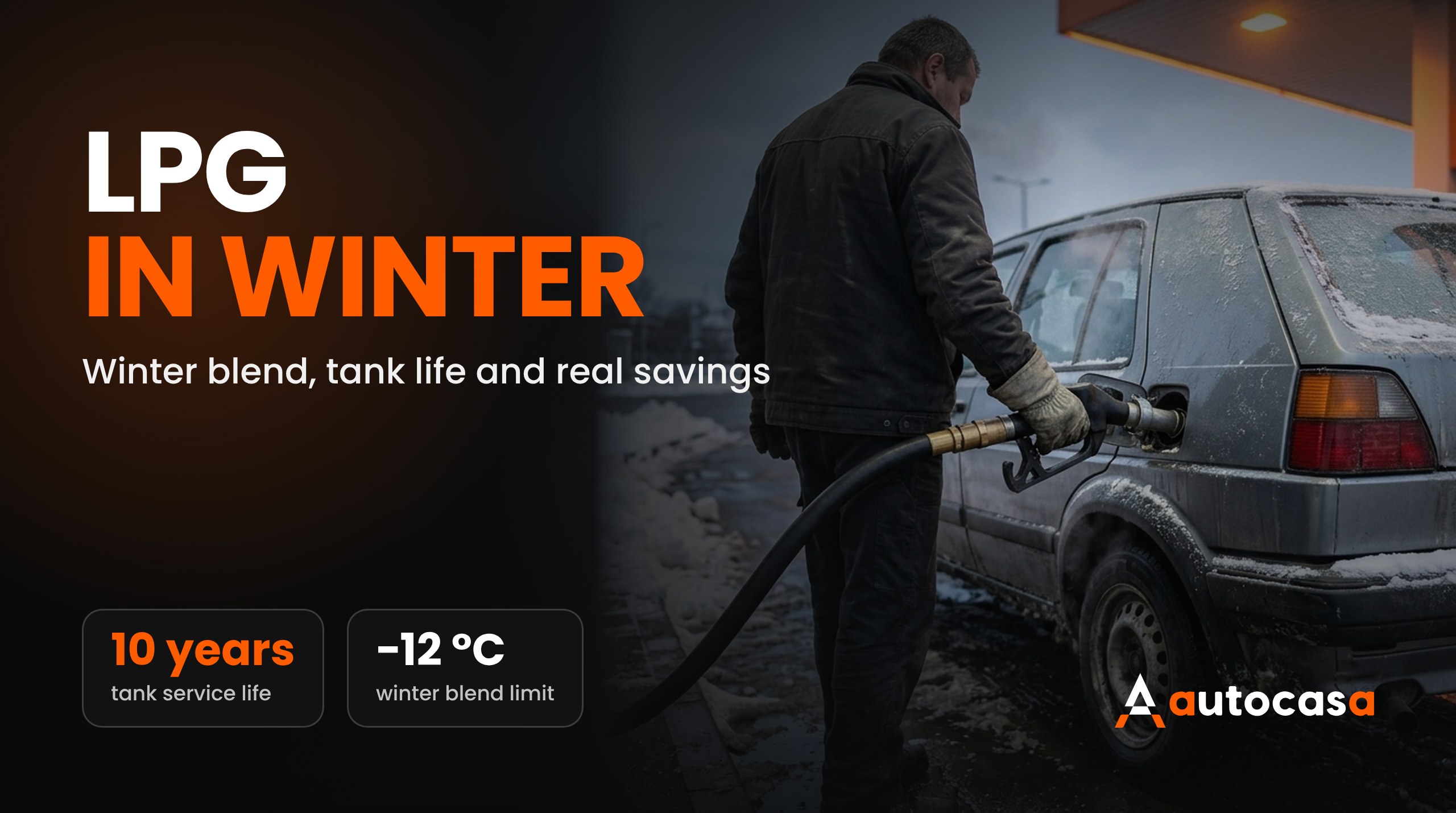
A litre of autogas in Slovakia now costs more than 60 cents less than a litre of petrol, but winter is the season when an LPG system exposes everything that was done carelessly during installation or servicing. Three things decide how your winter goes: the winter blend in the tank, the age of the tank itself and the condition of the system. It matters just as much to owners as to anyone currently looking at a used car in Slovakia or Czechia.
An LPG car always starts on petrol
No production gas system starts the engine on gas. The car fires up on petrol and only switches to gas once the reducer (vaporiser) has been warmed by the coolant to roughly 50 °C. In summer that takes about two minutes; in winter, easily three to four. Frost therefore does not cause the starting trouble at LPG that diesel owners know well.
One practical rule follows from this: never run the petrol tank completely dry. In winter the petrol phase lasts longer, and if there is nothing in the tank, the engine stalls after starting or will not start at all.
Winter blend: why the gas „stops working“ in December
LPG is not the same all year round. The summer blend contains roughly 60 % butane; the winter blend reverses the ratio to about 60 % propane and 40 % butane. The reason is physics: the summer blend vaporises down to around −5 °C, the winter blend holds up to roughly −12 °C. Filling stations are expected to offer the winter blend from 1 November to 31 March, and earlier when frost arrives sooner.
Drivers who refuel weekly never notice. The problem belongs to whoever filled up with summer blend in October and then parked the car. In December the gas simply will not vaporise: there is not enough pressure in the tank to push fuel to the engine. The car hesitates, will not pull, or switches itself back to petrol. The fix is dull but effective: run the tank low before the frost arrives and refill with the winter blend.
The tank lives ten years, counted from manufacture
This is the most expensive surprise when buying used. Under UNECE Regulation ECE R67, the service life of an LPG tank is 10 years from the tank’s date of manufacture — not from the date it was fitted, and not from the car’s model year. The date is on the plate welded directly onto the tank.
The distinction matters. If someone fitted a second-hand tank taken from another vehicle, it may expire within a year even though the installation is „new“. In Slovakia a vehicle with an expired tank is treated as technically unfit for the road and fails the technical inspection (STK). Czechia applies the same ten-year limit and the tank’s validity is checked at the inspection. A routine pressure test does not extend the service life — the tank has to be replaced.
What the Slovak inspection looks at
- The entry in the paperwork: gas must be recorded in the registration certificate as a combined fuel (BA+LPG). Without it, the system does not exist as far as the authorities are concerned.
- The installation report for the gas system and the installer’s supplementary plate, for conversions carried out in Slovakia.
- A pressurised leak test with gas detectors. Arrive with the tank at least half full — the test cannot be performed on an empty tank.
- Tank validity according to the plate.
- Emissions on both fuels. The car is measured on petrol and on gas. Failing either one means temporary fitness and 60 days to fix the fault and return.
- The engine warning light. An illuminated MIL is an automatic fail, and freshly cleared fault codes will not help.
What gas actually saves today
In week 46 of 2026, a litre of LPG in Slovakia averaged €1.008 and a litre of 95 petrol €1.611. Gas is consumed somewhat faster, though — realistically 10 to 20 % more, with 15 % the figure usually used.
In practice: a car that uses 8 l/100 km of petrol will burn about 9.2 l of gas. A hundred kilometres cost €12.89 on petrol and €9.27 on gas. That is a saving of €3.62 per 100 km, or roughly 28 %. At 15,000 km a year it adds up to around €540.
A conversion costs in the region of €900 to €1,400 on port-injection engines and €1,400 to €2,200 on direct injection. The maths works out better when buying a used car that already has the system than when converting one near the end of its life. In winter the saving shrinks a little, because every morning the first few kilometres are on petrol.
What to check when buying a used LPG car
- The tank plate — photograph it. Year of manufacture plus ten years is the date a new tank becomes your expense.
- The registration entry and the installation report. If the seller „has the papers somewhere“, wait until they find them.
- Who did the installation. An established workshop with its own service department is a different guarantee from an anonymous conversion done a decade ago.
- Service history of the gas system — filters and the reducer have their own intervals. If nothing has been replaced in the last 60,000 km, budget for it.
- A cold start on the test drive. Insist the engine is cold. Start it, let it switch over to gas and drive at least ten kilometres, including full acceleration.
- Where the tank sits. A toroidal tank in the spare wheel well is tidy, but then there is no spare wheel on board — in winter that is a real difference.
Buying or selling in Slovakia and Czechia?
With used LPG cars, buyers always ask the same questions. Put the tank’s year of manufacture, the installer and the date of the last filter change straight into the listing and you will save yourself dozens of messages. A photo of the tank plate in the gallery does more than ten lines of description.
On AutoCasa listings are free, with no sales commission and no limit on how many you post. Promoting a listing is optional and starts at €1.50. Alongside cars: motorcycles, vans and trucks, buses, trailers, spare parts, wheels and tyres, and bicycles.
This article describes the rules in force in Slovakia (Act No. 106/2018 Z. z.) and Czechia (Decree No. 153/2023 Sb.) together with UNECE Regulation ECE R67, as they stood in November 2026. These are not the rules of your own country. Fuel prices are Slovak average consumer prices for week 46 of 2026 and change continuously.


 Slovenčina
 Čeština
 Angličtina
 Nemčina
 Poľština
 Slovinčina
 Ruština
 Taliančina
 Maďarčina
 Francúzština


Zatiaľ tu nie sú žiadne komentáre. Buďte prvý!