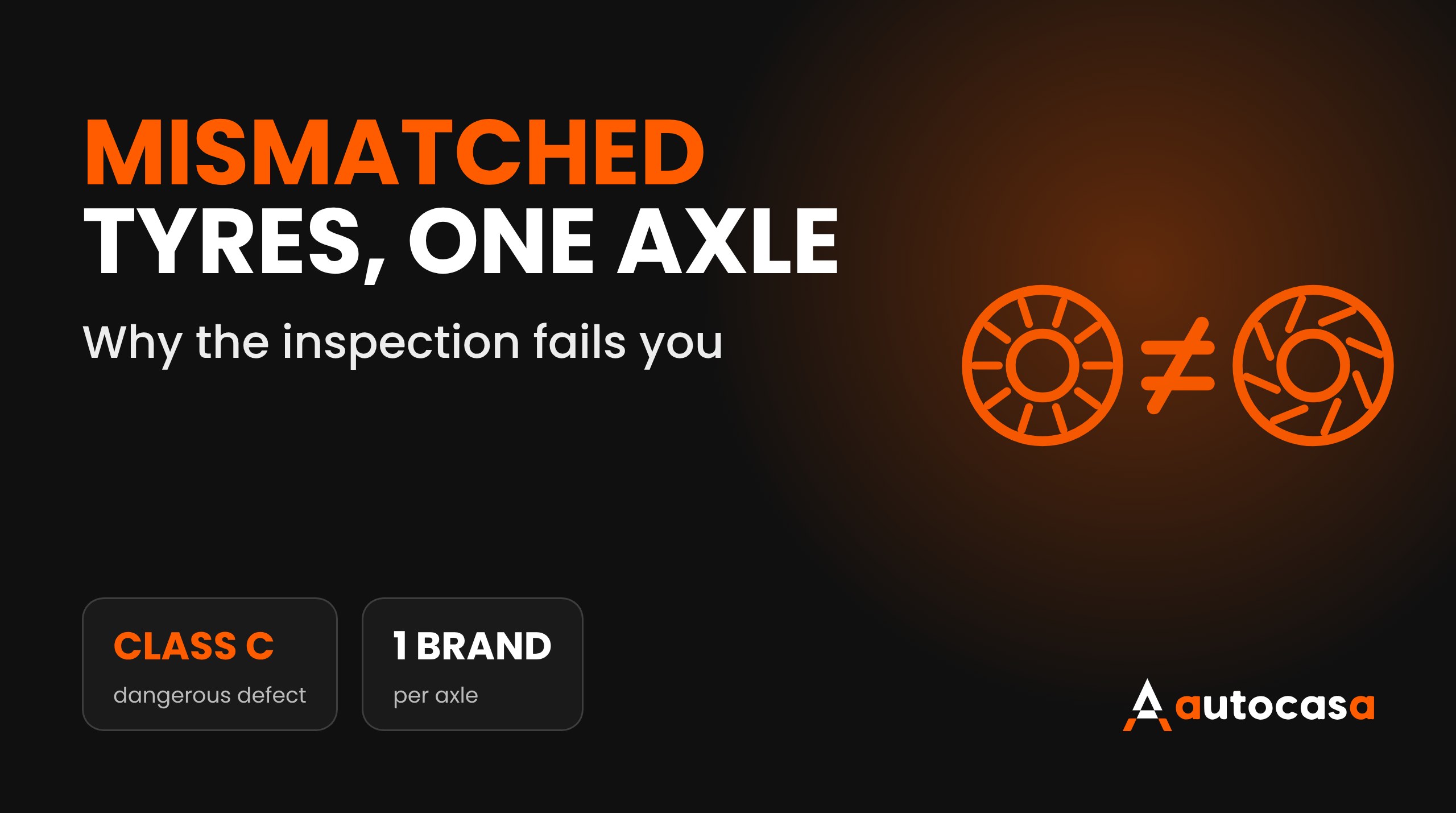
Tyre-change season is in full swing and the same scene repeats itself in every workshop: one tyre is finished, the other three will still do. So buy just the one? It sounds like sensible thrift, but this is exactly where thrift turns into a defect that fails the vehicle at its technical inspection. If you buy, sell or simply drive a car in Slovakia or the Czech Republic, it is worth knowing that the rules for tyres on a single axle are stricter than most drivers assume.
What „identical tyres on one axle” means under Slovak rules
Slovakia’s technical conditions for vehicle operation (Decree No. 134/2018 Z. z.) put it briefly: only identical tyres may be fitted on the same axle. Methodological Guideline No. 52/2018 for inspection stations spells out what that means in practice under inspection item 5.2.3. Identical does not simply mean „the same size”. The following are assessed:
- size and section width,
- construction (radial, diagonal, bias belted),
- category of use (summer, winter, off-road),
- the manufacturer’s commercial brand,
- load index,
- speed rating.
That leads to something many people find surprising: a Michelin on one side and a Continental on the other side of the same axle is not enough, even with an identical size, the same indices and almost new tread. The brand is part of the definition. The Czech Republic follows the same principle: Decree No. 153/2023 Sb. requires tyres on one axle to match in size, construction, tread type and commercial brand.
Why a mixed set fails the inspection
At the Slovak technical inspection, defects fall into three classes. A is a minor defect and the vehicle remains roadworthy. B is a major defect: the vehicle is marked „temporarily roadworthy” and you have 60 calendar days for the repair and a re-inspection. C is a dangerous defect: the vehicle is not roadworthy and may not continue its journey.
And that is the heart of the matter. A different commercial brand, category of use, load index, speed rating or section width on one axle is classified by the guideline as a class C defect. Mixing radial and diagonal construction on one axle is a class B defect. Unlike a cracked tail light, this is not a trifle you deal with „sometime before summer”.
A police patrol assesses the same technical condition at a roadside check. If the vehicle is judged technically unfit for operation, officers can issue a fine and also seize the registration certificate.
What a mixed set does to the electronics and to all-wheel drive
The rule is not there for its own sake. Two different tyres on one axle mean two different grip characteristics and often a slightly different rolling circumference. The consequences are very practical:
- Braking and stability: under emergency braking on a wet or snow-covered surface the car behaves asymmetrically and pulls to one side.
- ABS and ESP: these systems compare the speeds of individual wheels. A different circumference shifts their reference values, so they intervene too late or needlessly.
- All-wheel drive: differing rolling circumferences permanently overload the centre differential or the drive clutch. On SUVs and 4×4 models that can end in a repair bill of several hundred euros.
- TPMS: the pressure monitoring system may report false faults, especially after a tyre change.
The worst combination is a summer and a winter tyre on the same axle. Around freezing point their compounds have completely different hardness and the car responds unpredictably.
When a difference is allowed
Exceptions exist, but they are narrow. A spare wheel for emergency use may have a different size and construction if the vehicle and tyre manufacturer intended it for that purpose and it is approved under UN Regulation No. 64. The identical-tyre rule then does not apply, and at the inspection a space-saver fitted in place of a regular wheel is recorded only as a minor defect.
Different sizes on the front and rear axle are possible only where the manufacturer permits them and they are entered in the vehicle documents, typically on some sports models with wider rear wheels. Tyres must always match the data in the registration certificate. One more thing: regrooving the tread is completely prohibited on M1 passenger cars.
When buying a used car, look at all four wheels
During a viewing, the tyres are one of the most eloquent parts of the whole car, and all it takes is a walk around it. What to look for:
- Four different brands suggest the previous owner only fixed whatever had just broken. The oil and the brakes were probably treated the same way.
- Different tread depth left and right on one axle can mean poor wheel alignment or worn suspension.
- A worn inner or outer edge is the classic sign of alignment knocked out by a kerb strike.
- The DOT code reveals the age. Four digits, for example 3821, mean week 38 of 2021.
- Load index and speed rating should be compared with the registration certificate. Lower than the manufacturer prescribes is a reason to negotiate and to replace them immediately.
A new set of good winter tyres for an ordinary hatchback costs several hundred euros today, so mismatched wheels are a legitimate argument when talking about price.
Where to buy the missing tyre of the same brand
If one tyre from the set has given up, do not look for the nearest special offer but for the same model from the same manufacturer. A used one with comparable tread depth can often be found for a fraction of the new price.
On AutoCasa that is what the wheels and tyres category is for. Listing is free, with no sales commission and no limit on the number of listings; promoting a listing is optional and starts at 1.50 €. If, on the other hand, a complete set you no longer need is left in the garage after the changeover, state the size, manufacturer, exact commercial name, DOT code and remaining tread depth in your listing — that is precisely what a buyer completing a set with one wheel searches for.
The information in this article applies to Slovakia and the Czech Republic and is based on Slovak Decree No. 134/2018 Z. z., Methodological Guideline No. 52/2018 for technical inspection stations (item 5.2.3), Decree No. 137/2018 Z. z. and Czech Decree No. 153/2023 Sb. as in force in November 2026. Check the local rules for your own country.




 Slovenčina
 Čeština
 Angličtina
 Nemčina
 Poľština
 Slovinčina
 Ruština
 Taliančina
 Maďarčina
 Francúzština


Zatiaľ tu nie sú žiadne komentáre. Buďte prvý!