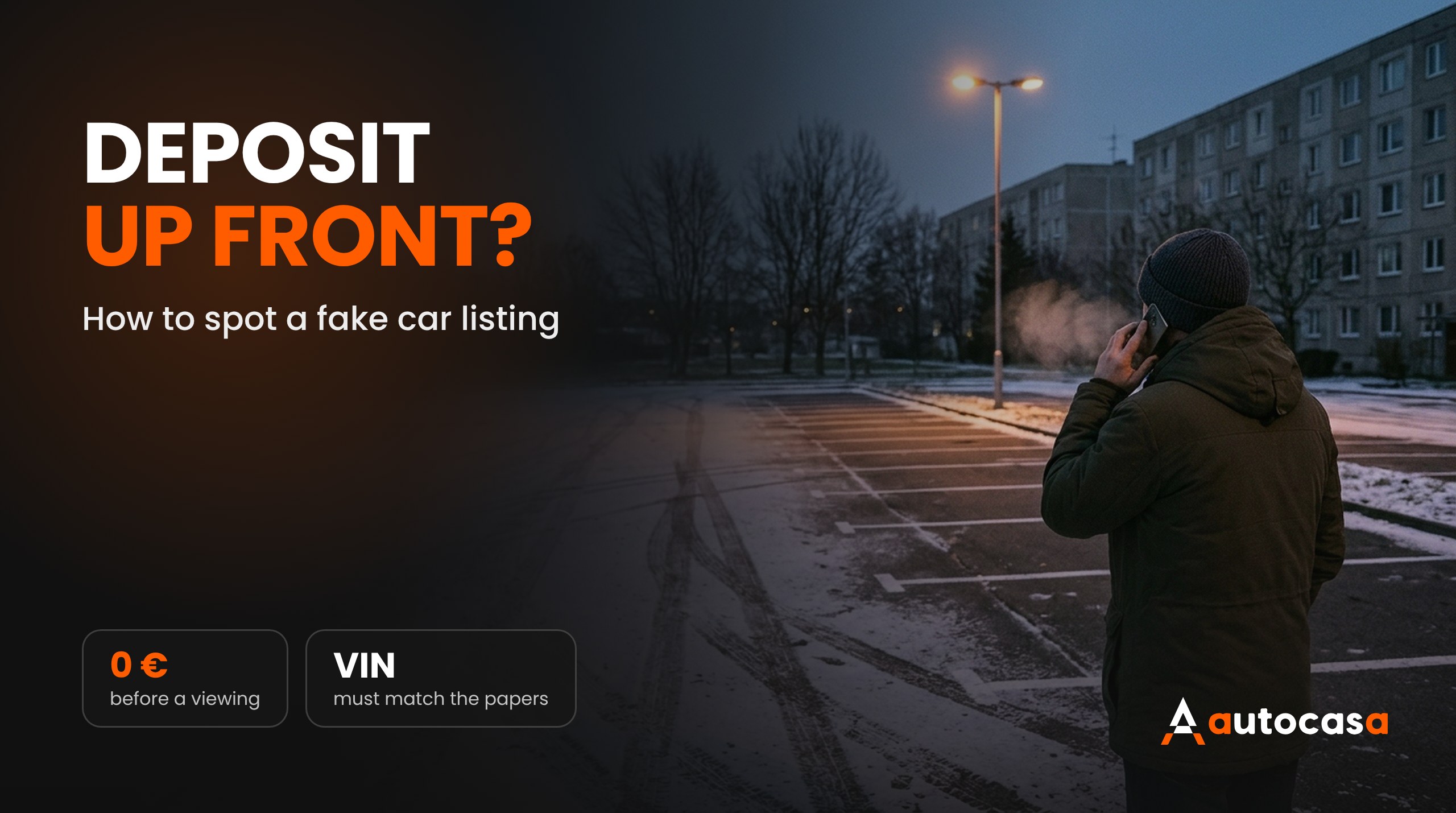
December is the busiest month of the year on the Slovak and Czech used-car market. Listings pile up, buyers have year-end bonuses in hand, and by the time work ends it is already dark for a viewing. That is exactly what fraudsters wait for: instead of a car they sell a story, and they ask for a deposit up front. Police in Slovakia and Czechia handle these cases every month, and the money comes back only in rare cases.
How the scam unfolds, step by step
The script is remarkably consistent, which is what makes it easy to spot. It starts with a listing where the car is fifteen to thirty percent below comparable examples. The moment you get in touch, you learn why: the seller is working abroad, is moving house, or is selling the car for a brother.
Next comes trust-building. The fraudster volunteers photographs of an identity card and a vehicle registration document, sometimes a sales contract as well. It looks like openness, but a photo of a document proves nothing: these papers are stolen, edited, or generated outright.
Then the pressure arrives. Several other people are supposedly interested, someone is coming to see it tomorrow, a decision is needed today. And because the seller is out of the country, he offers an elegant solution: you send a deposit, he arranges transport, and a carrier delivers the car to your door. The link to the transport company arrives by e-mail — and that site is fake, or borrows the name of a real company that knows nothing about it.
Once the money leaves, so does the seller. In April 2026 a man from the Stropkov area in eastern Slovakia lost 10,000 euros this way: for a car from Germany priced at 24,900 euros he sent two deposits of 5,000 euros each and received by e-mail a „reservation contract“ complete with a notary’s stamp and a certified signature. The car never arrived. In Czechia, a buyer from Hranice transferred 10,000 crowns to reserve a Škoda Octavia; in Pardubice, where he was supposed to collect it, nobody was waiting for him.
The warning signs that keep repeating
- A price well below the market. Compare five listings of the same year, engine and mileage: if the gap runs into thousands of euros, the reason is not good luck.
- The seller is „abroad“ or selling for someone else. On its own that is not fraud; combined with an up-front deposit, it is.
- Refusal to let you see the car. No exact address, no test drive, no viewing — the conversation ends there.
- Payment in advance to someone else’s account. The account holder does not match the name on the document, or it is a money transfer service.
- Transport „already arranged“ through a link in an e-mail. You choose the carrier, not the seller.
- The same photos in several cities. Run a reverse image search. If the same car is for sale in Bratislava and in Brno, the listing is copied.
- Odd phrasing and instant replies in the middle of the night. Common with listings run from abroad or through a hijacked social media profile.
What to check before the first euro moves
In Slovakia, data on a used vehicle, including recorded odometer readings, sits in the Register of Vehicle Operating Records at rpzv.sk. The entries come from roadworthiness and emissions tests, so a mileage figure that suddenly „went back“ by a hundred thousand kilometres shows up. Any lien on the car is in the Notarial Central Register of Pledges at notar.sk.
In Czechia the Ministry of Transport runs the free portal dataovozidlech.cz, where the VIN gives you technical data, the number of registered keepers and the validity of the technical inspection. Whether a vehicle is being searched for can be checked in the Czech police database at policie.gov.cz.
No register replaces the most important check: the VIN in the listing must match the number stamped into the body and the VIN in the registration document, and the name on the seller’s ID must match the registered keeper. That can only be established on the spot, with the papers in your hand.
Deposits, reservation contracts and carriers
In a private sale there is no reason to pay anything before a viewing. A reservation deposit makes sense with a dealer who has premises, a company number and a track record — and even there, send it by bank transfer with a clear reference, written confirmation of which vehicle and VIN it covers, and an agreement on when it is refunded.
A notary’s stamp on an e-mail attachment is not certification. A notary certifies the signature of a person who is physically present, and that can be verified afterwards with the notary in question. The same goes for „confirmations of funds held in escrow“: in this scheme they are forgeries.
If you are buying from a distance and genuinely cannot see the car yourself, send someone you trust instead of money, or pay for an independent inspection. A few dozen euros for a check costs less than a deposit that never comes back.
What to do if the money has already gone
- Call your bank immediately. A transfer ordered the same day can sometimes still be stopped, or the bank can request a recall of the funds. Hours matter here, not days.
- Delete nothing. Keep the listing as a screenshot, the entire conversation, the phone number, the account number, the e-mails and the payment confirmation.
- File a criminal complaint. In Slovakia at any police station, in Czechia at any police unit. You will need the complaint for the bank as well.
- Report the listing to the portal operator. Quick removal protects the next buyer — and the same applies in reverse, when a fraudster uses your photos.
The cheapest protection is an ordinary sale
Almost every one of these schemes depends on cutting the buyer off from the car and from personal contact. The safest purchase is therefore still the dullest one: you see the car, you see the papers, you see the seller, you pay on handover and you sign a contract.
If you are selling, make it easy for the buyer to verify you: real photos from several angles, interior and odometer included, the VIN, the service history, the reason for selling, and a viewing at your place or at a garage. A listing that hides nothing attracts more serious enquiries and sells faster.
On AutoCasa, listing is free, with no commission on the sale and no limit on the number of ads — for cars, motorcycles, vans and trucks, buses, trailers, spare parts, wheels and tyres, and bicycles. Promoting a listing is optional and starts at 1.50 €. So there is nothing to shorten or leave out in order to save money: put in everything you would want to know yourself.
This article describes rules and registers that apply in Slovakia and Czechia, not elsewhere. It draws on cases made public by the Slovak police (April 2026) and the Czech police (August 2026) and on police guidance for online buyers, current as of November 2026.


 Slovenčina
 Čeština
 Angličtina
 Nemčina
 Poľština
 Slovinčina
 Ruština
 Taliančina
 Maďarčina
 Francúzština


Zatiaľ tu nie sú žiadne komentáre. Buďte prvý!